

CONTEMPORARY AUTHORS/Bogdan-Alexandru Stanescu: Few authors today are willing to take the risk of being less likeable

Bogdan-Alexandru Stanescu is a writer, publisher and translator. In an interview with AGERPRES, he discusses his passion for mythology and the ancient world, his journey as a writer until discovering that prose suits him most as a genre, his walks through Bucharest, at different stages of his life, his work as a publisher and his perspective on the book industry in general.
Stanescu is also a translator and one of Romania's most renown publishers. He coordinated the Biblioteca Polirom series at the Polirom Publishing House for fifteen years, and currently heads the Anansi imprint at the Trei Publishing House.
His novel 'Copilaria lui Kaspar Hauser'/'Kaspar Hauser's Childhood' has received multiple major literary awards in Romania, as well as Chambery Festival du Premier roman prize/ Chamber First Novel prize, France, and was shortlisted for the European Union Prize for Literature. The novel was translated into French, Croatian, Hungarian, Bulgarian and Macedonian.
Stanescu's novel 'Abraxas' has also been translated into several languages, including French, and was published in 2025 by the prestigious publishing house Gallimard. It was also included by the Liberation magazine's list of the top 25 favourite books of last year.
At the end of 2025, Bogdan Alexandru-Stanescu was awarded a literary residency at the most recent edition of the Carturesti Literary Residencies programme.
AGERPRES: Your first book (2010) was an epistolary work co-authored with writer Vasile Ernu. It was called 'Ceea ce ne desparte. Epistolarul de la Hanul lui Manuc'/'What Keeps Us Apart. The Manuc's Inn Epistolary'. It started as a dialogue between friends during a casual meeting, and continued in the pages of cultural magazines. What was it like to resume the dialogue thirteen years later, in 'Centrul nu se mai sustine. Ceea ce ne desparte'/'The Centre No Longer Holds. What Keeps Us Apart' (2023)?
Bogdan-Alexandru Stanescu: When Vasile and I planned to resume this dialogue thirteen years later, I was curious to see whether we could still communicate as we used to. We hadn't collaborated for years, and our meetings had become increasingly rare. I read his books and liked to think he read mine, and I realized, with a mixed feeling of melancholy and satisfaction, that we actually get along better than we did when we were younger.
That's why, when we finally published a new volume of epistolary dialogues, 'The Centre No Longer Holds. What Keeps Us Apart' (2023), we also included our earlier letters, precisely because we wanted to bring both our versions together, as in a kind of 'before and after' exercise. The differences between our younger and older selves are significant, yet the joy of discussing literature remains, it's still there. We have matured, each in our own way, and it's clear that we've changed: Vasile has become more contemplative, while my interests in psychoanalysis and philosophy have taken a more radical turn. Back in 2010, it was Vasile who approached things through history, ideology, sociology, whereas I was more of a literary purist.
AGERPRES: Who is your favourite correspondent in literature?
Bogdan-Alexandru Stanescu: I'll give a quick answer: it's Flaubert, for his letters - closely followed by Joyce's letters (especially the letters to Nora, which I also translated). They both reveal the inner life of a radical artist, the kind who never compromise or settle for mediocrity. These are two portraits of maniacs.
Third, I would include Kafka's correspondence, which complements his 'Prague Diaries'. His letters feel more 'endearing', revealing his tragic desire to escape his own mind and destiny.
AGERPRES: Let's try a more challenging question: what would the portrait of a maniacal author look like today?
Bogdan-Alexandru Stanescu: Actually, the question is less challenging than it might seem. Given the current socio-economic pressures and the publishing industry's focus on profit, novelists today are more tempted than ever to cater to popular taste.
Very few authors today are willing to take the risk of being less likeable, of being provocative or controversial. True authors, to me, are precisely those who do not think about sales or the market, who do not regard book as a product, and who remain focused on their own stories and their inner coherence.
AGERPRES: Two years later, you published a poetry collection - 'Apoi, dupa batalie, ne-am tras sufletul'/'And Then, After the Battle, We Rested' (2012) - which some would call a 'delayed' debut.
Bogdan-Alexandru Stanescu: Any delay is considered as such only by reference to a certain standard. In poetry, that standard is the cliche of the young poet who burns bright and exhausts his/her ontological substance by the age of 30. This is a romantic cliche associated with tuberculosis and the national independence wars, and the spirit of 1848 revolutions, whereas 20th century humanist modernism proposes a new figure: the polymath, the wise poet, the metaphysical poet.
In my case, I postponed my debut out of fear - or should I say terror? In other words, I suffered from the imposter syndrome. I wasn't sure that the poetry I was writing had any value, so I turned to literary reviews, which I diligently practiced for more than a decade, weekly, although they did not bring me any joy. 2012 was the turning point for me in that regard, for this is the year when my first book broke through my mental barriers and demanded to be written.
AGERPRES: What was it that you disliked so much about writing literary reviews?
Bogdan-Alexandru Stanescu: I secretly thought I wasn't good enough for the job. I was pretending, and I was the first to realise that - before anyone else could. I felt very embarrassed every time I was called a literary critic. It was as I wanted the earth to swallow me. I also had this painful feeling that I was postponing the thing that mattered most to me, while wasting my time scrutinizing other people's books, 80 per cent of which didn't even deserve my attention.
AGERPRES: Is there still a need for literary reviews today?
Bogdan-Alexandru Stanescu: Absolutely. Writers are professionals, and I believe their work deserves professional assessment. That said, it's far from my intention to offend those critics who are not professionals, like bloggers, BookTokers, vloggers, participants in the book clubs - because they do play a very important role in the whole ecosystem.
However, a writer also needs to be read by someone who knows the history of world literature and that of their national literature by heart, who is able to identify the literary mechanisms at work in a book and classify them into synchronic and diachronic paradigms. To test a car, it is not enough to just know how to drive; you need to know how the respective model changed over time, compared to the previous models, determine its fuel consumption, see how fast it reaches one hundred km per hour, and identify its deficiencies.
AGERPRES: 'I kept my distance from circles of young writers,' confesses your alter-ego from 'Kaspar Hauser's Childhood' (2017), Bobita, and another character of yours, this time from 'The Black Sun' (2024), says something similar. Was it like this in your real life? Did you keep your distance from the young writers, your colleagues? If so, what did you think you lost and what did you gain by staying away?
Bogdan-Alexandru Stanescu: First of all, the two characters you mentioned, Bobita and Gigi Ibrahim, are not the same, not even at the level of discourse. Ibrahim, for instance, finds his two first loves - both eros and agape - while attending the literary circle he claims he hates.
My own case lies somewhere in between the two. I was drawn to groups of young writers, but at the same time I didn't feel like I belonged there. Part of the problem was that I was perceived as 'a literary critic', while I considered myself a poet. That is why I gradually distanced myself, especially from the moment when I became a publisher. And, as the saying goes, it's better not to get to know your idols.
AGERPRES: Your interest in mythology and the ancient world is evident in all your books, including in the name of the fiction collection you curate at the Trei Publishing House. Where does it come from?
Bogdan-Alexandru Stanescu: I've always felt that myth acts as a mirror, and that the mythological story should be interpreted from a symbolic point of view, much in the same way that we read our own minds. This is also what the Jungian approach to myth teaches us: myth becomes a gateway to the unconscious, but also its ultimate extension, that of mythology as a projection of the collective unconscious.
AGERPRES: While reading your books, the concept of 'psychogeography' (Debord, 1955) came to mind, which was inspired by the older one of the 'flaneur'. I thought of this because Bucharest almost becomes an extra character in your books, including your poetry. How much research did you do in addition to drawing on your own memories to reconstruct this city in your fictional universe?
Bogdan-Alexandru Stanescu: Well, I have traveled extensively through Bucharest, at different ages and at different times of day. I watched it change before my own eyes, while I myself was changing. I walked its streets, traveled by tram or subway before 1989, when we were all chasing after food, then in the 1990s; as a teenager, while running from an apartment party to another, in distant neighborhoods; in high school and university, when I rediscovered it through the eyes of my colleagues living on the university campus. I visited the hospitals, cemeteries and morgues. I navigated it as a young father with my shopping bags or my children on our way to kindergarten. And now I traverse it as a mature man, walking through downtown every day.
Over all those years, I memorised every crack in the asphalt, only to forget them later. I listened to so much music that now I can hardly stand it, and often I feel my eyes perceive the contours of the old city - the city of my childhood through the successive post-revolution layers, like a palimpsest. Deep down lies the Bucharest I only know from my grandparents' stories: the former Targul Mosilor area, Zidul Mortii, Vasilica si Marioara, Valea Plangerii.
So, you see, research is merely a way to keep imagination and memory under control. It is not an essential stage in writing.
AGERPRES: Who would you say is your favourite flaneur from literature? Joyce, perhaps?
Bogdan-Alexandru Stanescu: Yes, Joyce is one of my emblematic flaneurs, but he is not at the top of the list. He is rather somewhere in the middle. Although atypical, Nietzsche seems to me an admirable laborious flaneur. Then come Baudelaire, E.A. Poe, Virginia Woolf, Walter Benjamin (obviously), and even Will Self, our contemporary.
AGERPRES: 'And I said to myself, with satisfaction: what an aesthetic being I've became, how objective' are two lines from 'anaBasis' (2013). How far did you think you've come in this process of becoming objective, after three novels, three poetry volumes and two essay books?
Bogdan-Alexandru Stanescu: Quite far. This is a path that I needed to walk in order to reach the stage of objectivity I had wished for ever since 2013, but without the possibility of doing shortcuts. Especially in prose, I struggled to free myself from the tyranny of the I, in order to be able to tell someone else's stories. In a way, I wanted to follow a path specific to myth, in the sense of projecting into the objective substance of the word.
AGERPRES: 'Kaspar Hauser's Childhood', your first novel, won the most prestigious literary awards in Romania, and also two major awards abroad, and it was translated into several languages. Were you taken by surprise by the success of this novel? Especially that it is also your first.
Bogdan-Alexandru Stanescu: For me, this crossing of the Rubicon - a mere trickle of water, really - from poetry and essays into proper prose was very important. For years I carried its spectre over my shoulder, yet I kept postponing the moment for various phantasmagorical reasons. In a way, in my case, prose was born at the intersection of poetry, essays and literary criticism, all of them genres that I was practicing imperfectly, like I was cheating, in a way.
It was only when I began writing prose that I understood that this was what I was meant to do. This doesn't mean that I stopped writing poetry or essay. On the contrary, I would say that now I can do that with much more ease. I feel freer. And no, I was not surprised by those awards, I was just glad. It was just the best prose that year, objectively speaking.
AGERPRES: While Bucharest represents the geographical backdrop of your books, the 1990s seem to be the most extensively explored time. This also fits into the recent recovery of that particular decade in Romanian literature. But does this era spark as much interest among foreign readers as earlier books about communism once did? I am referring to Eastern Europe here, of course.
Bogdan-Alexandru Stanescu: Actually, the 1980s are as heavily represented as the 1990s. The former was a decade of miracles (hunger was a miracle, the passage from early to later childhood was miraculous, the power cuts every evening were miraculous too, and my mother's face in the candlelight was also a miracle), while the 1990s meant chaos, violence, adolescence, music, MTV.
I don't know how much interest it raises. If we take a closer look at Romanian books translated into other languages, I don't think that we find a common theme. But we do need to recover that period, as you said, because it represents the soil in which our present is rooted. The politicianism, the hypocrisy that became almost a lifestyle, and even nationalist populism are rooted in these two decades. However, at the same time, we cannot deny the existence of a universal nostalgia, especially when thinking of the 1980s, a nostalgia for the simplicity of life, for a kind of 'decent poverty'.
Lets take the case of 'Stranger Things', for instance, the series we are all passionately watching together with our teenage children. It is not the Demogorgons that make us watch this series, but the nostalgia for a bygone era that still feels surprisingly close to us.
AGERPRES: Can we say that the 1990s were the savage childhood of capitalist Romania, what do you think?
Bogdan-Alexandru Stanescu: Considering the fact that the first 'capitalists' came from the second echelon of the Party and from the Securitate, I would say that the 1990s were rather the adolescence (of Romanian capitalism - editor's note), or its prefrontal lobe trapped in internal explosions, the alchemical still in which the black matter of the present was formed.
AGERPRES: Your novel 'Abraxas' was published in France by the prestigious publishing house Gallimard, in its 'Du Monde Entier' collection, translated by Nicolae Cavailles. It was also published in other countries, such as Poland, Bulgaria, Macedonia and Serbia, which makes it a great success. How difficult is it for a Romanian author to have his books translated into other languages? Tell us a little bit about the process.
Bogdan-Alexandru Stanescu: Well, first of all I should say that I owe this to my publisher, Laura Susijn. I also owe it to the fact that the novel received numerous awards in Romania, of the most prestigious ones (the Observatorul cultural Award, the award granted by Ziarul de Iasi, the Academy Award). However, to give a more precise answer to your question: initially, I was the one to ask Nicolas Cavailles to translate a significant number of pages from the novel (close to 50 pages), in order to show them to potentially interested publishers later.
This is a rather difficult process, and it is less glamorous than in the case of commercial books, which can be sold in up to 20 different territories in a single month. Literary fiction takes time to sell; the process is much longer, and too often nothing comes of it. The criticism that I received was that the novel was too long. And there was also the unspoken criticism that I was a Romanian author, I would add.
AGERPRES: But what's the problem with Romanian authors? What biases are at play this time?
Bogdan-Alexandru Stanescu: It is exactly the same prejudice that the Romanian publishers had when they refused for years to publish authors from our neighboring countries: Bulgarian, Serbian, and Ukrainian authors. 'They don't sell,' I was told when I asked why they refused to translate a very good Serbian author. And, indeed, for a while it was true that such authors didn't sell. However, at that time, we had a lot of catching up to do in terms of translations. There were great British, French, American authors whose work we also needed to translate, while the Romanian readers were first of all hungry for books in that latter category.
However, in the meantime, after the Anglo-Saxon tsunami of commercial literature hit us hard in recent years, I believe that we've reached saturation and the readers are already 'a little bored' with these literatures. Suddenly, a brilliant Bulgarian author, a very talented Serbian, or a very intelligent Croatian woman author have become fresh alternatives. And I hope that this will happen to us too. Until then, however, we need to keep writing.
AGERPRES: You worked with Lora Nenkovska on the Bulgarian translation of this novel, 'Abraxas', during her stay in Bucharest as part of a New Europe College project. Tells us a little bit about this experience.
Bogdan-Alexandru Stanescu: Lora is the kind of translator who never leaves a detail unchecked. After she finishes a translation, she makes lists with questions - her doubts related to one word or another, words whose meaning may seem unclear to her. Then she tries to translate into images all that the words describe, and she asks: What did this concrete slab look like? Was that a winding path through the trees? We took the opportunity offered by the NEC scholarship and went for long walks. We walked the streets of Bucharest looking for all the places in 'Abraxas', while discussing at the same time all the different linguistic registers in the novel - especially the slang.
AGERPRES: Despite the recurring themes, including the heaviest ones such as the absence of the father figure, 'The Black Sun', the third volume of the trilogy that began with 'Kaspar Hauser's Childhood' and continued with 'Abraxas', goes much further, in the sense that Romania, both before and after 1989, becomes a much more complex, almost mystical land, with sensational elements also present. Did you feel somewhat freer as an author while writing this book?
Bogdan-Alexandru Stanescu: I used the same recipe in 'Kaspar Hauser', somewhat timidly, both in 'The Crematorium' and in the last chapter, where mythology slipped its tail through the cracks in the wall of realism. In 'Abraxas' I used the formula of imaginative memory to be able to explore distant spaces and times. In 'The Black Sun' I no longer needed such tricks.
I don't know if I felt freer. I think I was rather more 'in control' of myself. Given that we are talking about a thematic trilogy, however, it must be said that in the first novel the Father is not absent, but rather too present: he is a Father who brings language, communication, play and filth. In 'Abraxas', his role is taken over by the mother, by Princess Ralu, a dragon-mother who devours men and suffocates her son, predestining him to failure.
In 'The Black Sun', the main character is the family triad - a closed, violent unit - from which Gigi Ibrahim escapes only after forty years.
AGERPRES: You are among the very few Romanian writers who have a literary agent. How important is it for an author to have a literary agent?
Bogdan-Alexandru Stanescu: It depends on what you want to achieve. I think that if you have time available and are willing to learn, you can manage well even without an agent. I work ten hours a day, so I cannot afford the luxury of being my own agent. Another important thing, which I understood late, is to avoid large agencies. As a Romanian writer of literary fiction, you will not receive much attention from them.
Returning to the question, no agent is going to work miracles for you; you must work just as hard, especially because, in the case of a foreign agent, they lack direct communication with your text, so up to a certain point they will have to rely on trust. But there are many aspects of a novel that cannot be 'explained.' The voice cannot be explained, and neither can atmosphere.
AGERPRES: You have translated James Joyce, Tennessee Williams, Louise Gluck, William Faulkner, C.G. Jung, Anne Carson, prose, drama, poetry. Which was the most difficult book you translated?
Bogdan-Alexandru Stanescu: I haven't taken on easy books to translate, only books that I liked. No matter how difficult they were, the pleasure of translating often surpasses that of writing. There are moments when I am writing and I feel like a hamster running on a wheel. Writing becomes dry and repetitive. Translation is never like that.
Each author was 'difficult' in their own way: Faulkner, because you must always remember where the endless sentence began; Anne Carson, because she alternates mythological and realistic planes while shifting them at the same time on the stylistic board. But actually, I never remember the 'difficulty' of a translated book. I only remember how that book made me feel, for each one comes with its own unique mood.
AGERPRES: You joined Polirom Publishing House's collection of fictionalised biographies with a novel about Caragiale. Is there anything new that can still be said about Caragiale?
Bogdan-Alexandru Stanescu: About Caragiale, no. But about the character that Caragiale was - yes, absolutely. In fact, I did not set out to write a work of literary history or criticism (although I read extensively both works about him and his own works). I set myself the task of writing exactly what was required of me: a fictionalised biography. Another challenge, which I've spoken about before, was to capture Caragiale's voice, the one from his letters, which I find extraordinary.
AGERPRES: You are an author (prose writer and poet, essayist), editor, and translator. How do you split your time between these three passions and professions of yours? Are you very disciplined, or do you work more chaotically?
Bogdan-Alexandru Stanescu: I am far from being disciplined! On the contrary, I'm a child of chaos - albeit a tempered one. To answer your question: I work all the time. And when I'm not visibly working, I'm still working in my head, either consciously or unconsciously. It often happens that I cross the street on red lights, bump into poles, or suddenly realize that the person in front of me is looking at me in confusion, waiting for an answer to a question.
What helps me, however, is the fact that everything I do revolves around my love for books in general and literature in particular - a love that nothing has managed to cure me of.
AGERPRES: You have published, under the Anansi imprint, four of the six authors who have won the Nobel Prize for Literature in the past six years: Laszlo Krasznahorkai, Annie Ernaux, Jon Fosse and Louise Gluck. What is your secret? And perhaps you could tell us who will win the Nobel next year?
Bogdan-Alexandru Stanescu: I've said it before that there is no secret. I just work long hours, I am very careful in selecting the authors and, above all, I am very passionate about what I do, in a profession that is increasingly becoming an industry. If you remember that you entered the book market out of love for literature, you will for sure build a strong catalogue.
So no, I can't tell you who will win the Nobel. I can only tell you that I would like it to go to Mircea Cartarescu. And if not, then Anne Carson.
AGERPRES: At the end of last year you published a second volume of essays, 'Pestii cubanezi'/'The Cuban Fish', which emerged as a reaction to a heated discussion centred on your novel 'The Childhood of Kaspar Hauser'. Do you always manage to turn negative experiences into positive ones?
Bogdan-Alexandru Stanescu: Not necessarily. What I do, however, is exploit my obsessions - I don't let any irritation or dissatisfaction pass me by. I use writing to stitch up the wounds of life. That's my only talent. In the case of 'The Cuban Fish', it wasn't so much that small scandal that caused me to write the book, but rather the fact that I felt the need to take a break from prose without stopping writing altogether. I wrote it in parallel with a 'verse novel' that I'm still working on and which was clearly inspired by my translation of Anne Carson. That's how everything connects: editing books, personal reading, writing, life.
AGERPRES: Also at the end of last year, you won the Carturesti literary residency. Tell us a little about the project you submitted - the one you are currently working on, presumably.
Bogdan-Alexandru Stanescu: Out of superstition, I don't want to say anything specific about the novel I'm working on. But I can say that it's a triptych novel, a mixture of prose, poetry and theatre, built around a historical pretext. I'm interested in the point of intersection between mythology, sex and power. In addition, I want to explore the third person more insistently - a technical threshold I've only partially crossed so far.
AGERPRES: And a final trick question: what does Romanian literature lack most today?
Bogdan-Alexandru Stanescu: A trick answer: nothing intrinsic. It lacks time, it lacks space, it lacks money. 'A room of one's own'. We are a professional category condemned to practise our craft after eight to ten hours at the office, after raising our children, doing the shopping and taking care of our parents. And then we are expected to deliver the formal perfection of a writer who has financial independence.
We have no grants, no residencies, no concern whatsoever from a state preoccupied with its own corruption. The only grants and residencies come from the private sector, just as education in recent decades has been left on the shoulders of publishing houses, while successive governments have been busy changing ministers of Culture and Education year after year and carrying out reforms for the sake of reform. The Romanian writer seems to be, plainly put, nobody's responsibility.
BOGDAN-ALEXANDRU STANESCU (b. 1979) is a novelist, poet, essayist, translator and editor, editorial director of the Anansi.World Fiction imprint (Trei Publishing Group). He made his debut in 2010 with the epistolary work 'What Keeps Us Apart. The Manuc's Inn Episolary' (co-authored with Vasile Ernu), and in 2012 as a poet.
He has published the novels 'The Childhood of Kaspar Hauser' (2017), 'Abraxas' (2022) and 'The Black Sun' (2024), all of which have received major literary awards in Romania and abroad. In 2025 he published the essay volume 'The Cuban Fish'. His novels have been translated into several European languages, and 'Abraxas' was published by the prestigious French publishing house Gallimard. He has translated works by, among others, James Joyce, William Faulkner, Louise Gluck, Anne Carson and C.G. Jung. AGERPRES (RO, EN - writing by: Cristina Zaharia; RO - editor: Mariana Ionescu)
The content of the www.agerpres.ro website has the exclusive purpose of public informing.
All the information published on this website by AGERPRES is protected by relevant legal dispositions.
It is forbidden to copy, reproduce, recompile, decompile, distribute, publish, display, modify, create derived components or products or full services, as well as any exploitation of the site's content.
Details in the section Terms of Use. If you are interested in picking up AGERPRES news items, please contact the Marketing Department – marketing@agerpres.ro.
The use of the Comments section entails your obligation to respect the AGERPRES terms and conditions in regards to the publishing of comments on the www.agerpres.ro.
Other news in category
Interim FinMin Nazare calls for more capital for Romanian companies at ECOFIN
Romania called, at the Economic and Financial Affairs Council (ECOFIN) meeting, for the integration of European capital markets to facilitate Romanian companies' access to financing and take into account the specific characteristics of developing markets, interim Finance Minister Alexandru Nazare said in a post on his Facebook page. 'I called for more
President Nicusor Dan at PNT Centenary: Democracy is being called into question today
President Nicusor Dan said on Saturday that democracy is now 'being called into question' and warned that 'waves of hatred' are sweeping through society 'at every opportunity' with populism unfortunately on the rise in Romania. The head of state attended an event on Saturday marking the Centenary of the National Peasant Party.
Grindeanu: PNL's participation in Gov't is not a favour to PSD, but the right decision for Romania
The National Liberal Party's (PNL) participation in the Government is not a favour to the Social Democratic Party (PSD), but the right decision for Romania, PSD leader Sorin Grindeanu said on Saturday. 'Mr Bolojan, the economic deadlock and the hardships Romanians are facing will not disappear simply because you choose to treat them with irony. People&
PM-designate Niculescu on Romania's accession to OECD: Technically speaking, we are ready;there is still one small detail
Prime Minister-designate Luca Niculescu, Romania's negotiator for the accession to the Organisation for Economic Co-operation and Development (OECD), said on Friday that Romania is 'very close' to joining the organisation, mentioning that there is still one 'small detail' to be resolved by a fully empowered Government. He said that Romania&

Governing program I prepare is for period leading up to next elections (PM-designate Niculescu)
Prime Minister-designate Luca Niculescu stated on Friday that he does not aim to form a government with a short lifespan; he noted that he is conducting negotiations with party leaders and does not rule out the inclusion of politicians in the government. 'There are people I have considered, obviously I cannot name them, but this will also depend on the cab

BrancusiYear/Brancusi's 'The Prayer' - highlight of 'The Sacred Feminine' exhibition organised at Metropolitanate Museum
Constantin Brancusi's 'The Prayer', regarded as one of the masterpieces of Romanian sculpture, is on display from 9 to 30 October at the Museum of the Metropolitanate of Moldavia and Bucovina, as part of the exhibition 'The Sacred Feminine: From the Creation of the World to Brancusi's Prayer', organised by the Archdiocese of Iasi in collaboration with

Presidential Administration: Romania will support adoption of ambitious European budget
Romania will support the adoption of an ambitious European budget that maintains overall funding levels for Cohesion Policy and the Common Agricultural Policy, the Presidential Administration announced following a working meeting convened on Friday by President Nicusor Dan regarding the Multiannual Financial Framework, ahead of the European Council meeting on October 15-16.
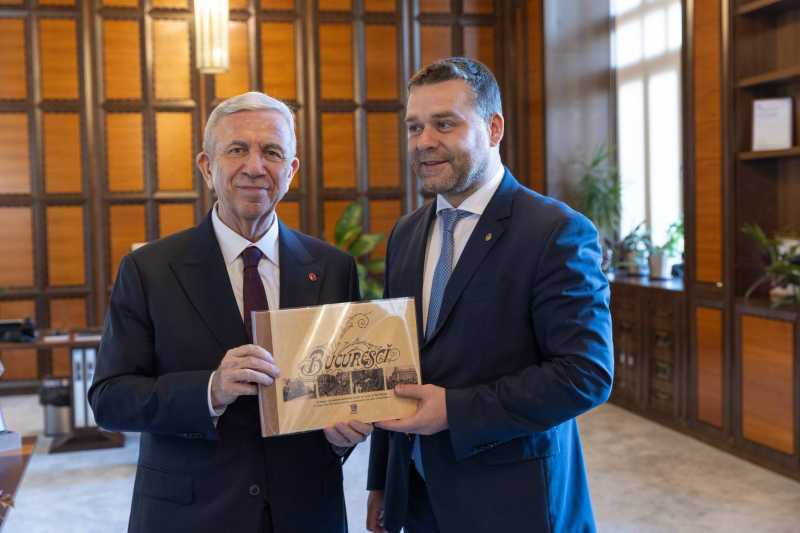
Ciprian Ciucu and Mayor of Ankara discuss development of economic and cultural relations
The Mayor of the Capital, Ciprian Ciucu, discussed with the Mayor of Ankara, Mansur Yavas—who was visiting Bucharest—ways to improve the connection between the two cities to foster tourism development as well as economic and cultural relations. Ciucu noted that Bucharest and Ankara have been sister cities since 1998 but have not had very close ties

Politicians, diplomats, students attend Romanian Holocaust remembrance ceremony in Bucharest
The 'Elie Wiesel' National Institute for the Study of the Holocaust in Romania held its annual commemoration ceremony on Friday at the Holocaust Memorial in Bucharest. In his remarks on this occasion, Senate President Mircea Abrudean said that Romania must fully own up to its role in the tragedy, stressing that 'the Romanian state must acknowledge

'Basarabia' Association demands recall of Romania's ambassador to Ukraine over Romanian-language education crisis
The founding president of the 'Basarabia' Association in Odessa, Anatol Popescu, has called on President Nicusor Dan and acting Foreign Minister Oana Toiu to assess the possibility of recalling Romania's ambassador to Ukraine, Alexandru Victor Micula, accusing him of an 'unacceptable' and 'counterproductive' handling of the crisis surrounding Roma
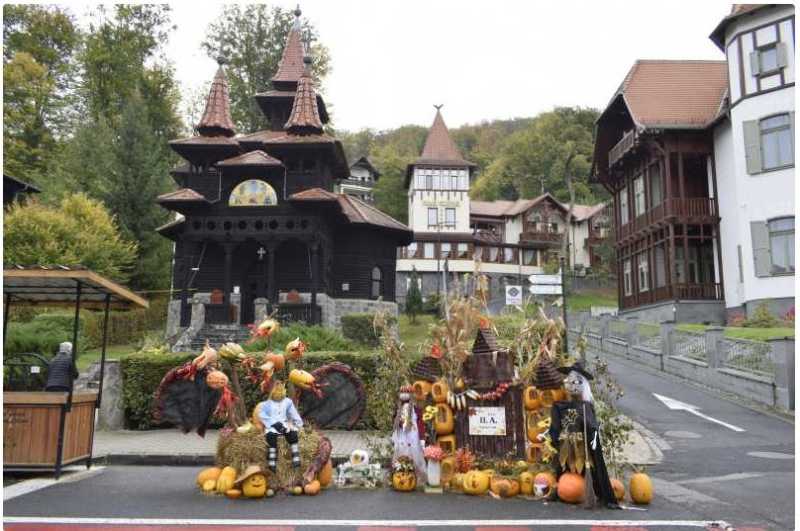
FEATURE/Sovata resort fully booked for Pumpkin Festival; 2,000 pumpkins purchased for schools alone
The sound of brass bands echoed through the streets of Sovata on Friday as hussars, schoolchildren and locals launched the 11th edition of the Pumpkin Festival, an event that has transformed the Transylvanian spa resort from a traditional off-season destination into one of Romania's most popular autumn attractions. What began more than a decade ago as a mo

Government: Romania's observer status within ELI ERIC extended by two years
The government approved on Friday a two-year extension of Romania's observer status within the Extreme Light Infrastructure - European Research Infrastructure Consortium (ELI ERIC). At the same time, the conditions for Romania's potential accession as a member will be evaluated, according to a statement from the Government Press Office.
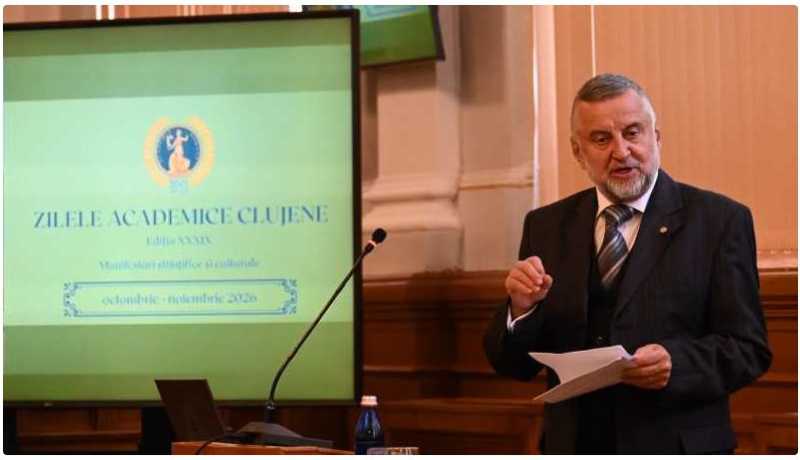
Philosopher Codoban: The new type of researcher to win Nobel Prize will work in partnership with AI
Philosopher and essayist Aurel Codoban, a corresponding member of the Romanian Academy, told AGERPRES that Artificial Intelligence (AI) will win the Nobel Prize in the near future. 'I believe it will win [the Nobel Prize] and there are sound reasons for this. There is a project underway in this direction; in March, a Japanese-Indian team proposed building
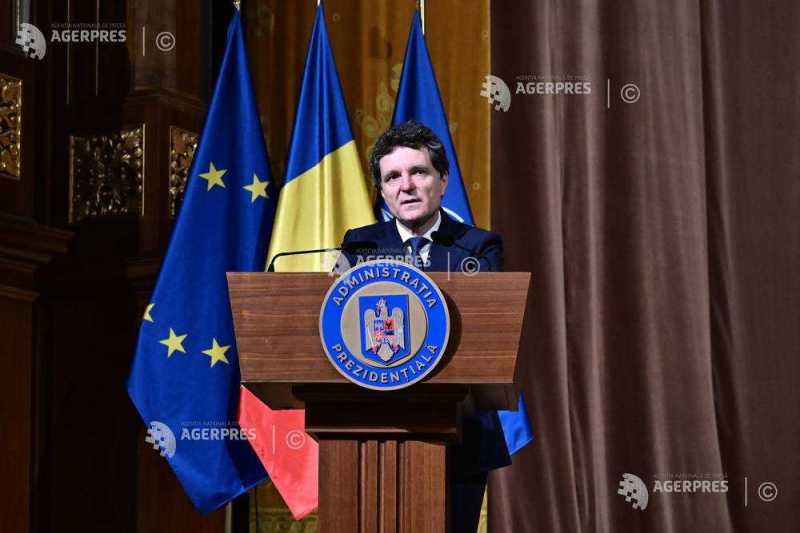
President Dan on National Holocaust Remembrance Day: Turning to memory and history is crucial
President Nicusor Dan said on Friday, on Romania's National Holocaust Remembrance Day, that turning to memory and history is crucial to understanding how the crimes and atrocities committed on Romanian territory were possible, with the involvement of the Romanian state authorities and the complicity of those who remained indifferent. 'Today, we pay tri
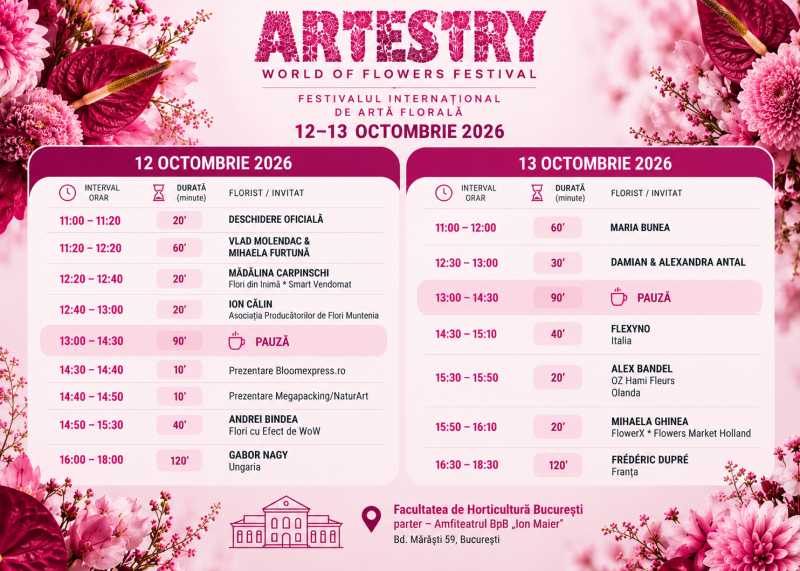
Artestry World Of Flowers Festival brings world champions of floral design to Bucharest
World and European floral design champions, artists and leading figures from the flower industry will gather in Bucharest on 12 and 13 October for the fourth edition of Artestry World of Flowers, the International Floral Art Festival. The event, organised by the Faculty of Horticulture at the University of Agronomic Sciences and Veterinary Medicine of Buchares