

CONTEMPORARY AUTHORS/Ariana Harwicz: Writing should always be radical
Ariana Harwicz is an Argentine author, one of the most appreciated voices of the contemporary Latin-American literature, who was also a guest of the International Literature and Translation Festival (FILIT) taking place every year in Iasi, Romania. She granted an interview to AGERPRES, in which she talks about the themes that interest her most, such as immigration or family, about the importance of language in her novels and what helps her to shape his unique style, about music and the many faces of an artist.
She also talked about the political dimension of her novels, which is more or less explicit, and about the manner in which the political perspective helps her to better connect to her characters, and to better understand their suffering, anxiety, rebellion and their hatred of the world.
The author also mentioned the manner in which she got involved in the stage adaptation of her novels and about the film adaptation of her novel 'Die, My Love', which has been translated into Romanian, and recently republished. The film, which bears the same title and was directed by Lynne Ramsay, with Jennifer Lawrence and Robert Pattinson playing the main characters, was part of the official selection at the Cannes Film Festival this year, and is currently running in the Romanian cinema halls as well.
Ariana Harwicz has three novels published into Romanian, 'Die, My Love', 'Degenerate' and 'Losing the Trial', all of them published by the Vellant Publishing House (2019, 2022 and 2024).
AGERPRES: Dear Ariana, you have three novels published into Romanian, so far, and in all of them immigration is a central theme, would you say that this topic, 'immigration', is like the backbone of your writing?
Ariana Harwicz: I would say that the backbone or the spiritual core of all my texts is immigration as a state of consciousness of being a foreigner. Many authors have conceived writing in this way, actually. Which is not the same, through, with saying that one cannot write without experiencing depersonalisation and perceiving oneself as a foreigner.
But, at least for me, I don't think I would have been able to achieve the necessary detachment to write otherwise, although I do think that it's not necessary to be an immigrant to feel it. Many have experienced it during wars, for example, during deportations, and so on.
AGERPRES: In all the three books the backdrop for the action is a village. Why is the village so important an element in your novels, what makes it so special?
Ariana Harwicz: Well, what you are saying here is very good. The backdrop is a great image because all my novels are a bit like a play, a kind of model, a sort of fake house, a cardboard house, a house designed for the stage, and the village is imaginary. It's not that it's a real village. The real village doesn't matter. The village exists in the fictional, literary imagination that is created in my head. The village works perfectly for all the conflicts that start to unfold between the characters, for the extreme loneliness they feel, for their marginality and illegal ways, but I am always aware that it is actually a construct. It's like... if we think of a painter choosing a color palette, well, let's say that the village in my books is made of language.
AGERPRES: All the three books published in Romania are very dense, in terms of language, as your characters are struggling to make themselves understood, in the very literal sense, as foreigners facing language and cultural barriers, but also in every other sense, psychological, philosophical, ontological etc., but at the same time your phrases are very melodic. Do you listen to music when you write?
Ariana Harwicz: Yes, music helps me to establish a relationship with language that is unique. Or, in other words, that uniqueness in language comes to me from silence and the piano. So, yes, I alternate silence with the piano when I write. And, actually, I can't imagine writing without that relationship with silence and music.
But this is not to say that music helps me to create a certain atmosphere - it's more like music directly helps me to create a new language.
AGERPRES: Your books also have a cinematic dimension, and your writing was even compared to iconic film director David Lynch's style, probably due to the dreamlike, even nightmarish, aesthetic, and dark tones. Does this comparison make any sense to you?
Ariana Harwicz: Well, being compared to David Lynch or others is, of course, flattering, because the comparison in itself is an attempt to find a stylistic equivalence to the lyrical, as you say, the nightmarish, the indeterminacy between life and dream in my novels. And, well, I can see where the comparison comes from, of course.
However, what I do know for sure is that nothing was premeditated in that respect. I planned nothing of the sort. One always seeks inspiration in something a bit uncertain, in many things at once, and then, of course, the readers link what's in there to other works, they draw comparisons between the different works and so on, but that is always a side effect, something that comes later, after the writing is done, and the work is finished.
AGERPRES: You studied performing arts back in Argentina and it feels like your novels have a type of dramatic construction that kind of resembles that of a script, can you tell us a little about how you build your novels?
Ariana Harwicz: Well, yes, I studied film scriptwriting, dramaturgy, theatre, painting, philosophy, and cinema. And I do think that, when it comes to writing a novel, literature alone is never enough. I never feel like I'm only writing literature. I even find that impossible, actually. What happens is that one uses all the elements at one's disposal to create something, to write. It could be music, painting, visual arts, photography, philosophy - literature alone is never enough. There's no way for my mind to produce just one thing.
In the past, artists were always many artists at once. They came from areas such as astrology, astronomy, painting, philosophy, medicine. In the same way, a writer is always many people at once, and many things at the same time, and a novel is always more than just a novel. For instance, I like authors who come from other fields of activity, like the famous writers who were also doctors.
AGERPRES: Your first novel published into Romanian, 'Mori, iubitule'/'Die, My Love', which is also your first novel published into English, has been adapted for film. The film, which bears the same title, was directed by Lynne Ramsay, while Jennifer Lawrence and Robert Pattinson are playing the couple in the book, I imagine you watch it, did it meet your expectations?
Ariana Harwciz: I watched the film at the Cannes Film Festival, yes, on the day of its world premiere, when it was competing in the official selection, together with the actors and the technical team. And honestly, it did meet my expectations, because it's a variation, a reinterpretation, a translation - a new reading of the novel - and at the same time, while being all of that, it's also something completely different. It's absolutely the same and yet entirely different - it's like being identically distinct, or absolutely different in sameness. And I also think that play of mirrors was maintained, and that's important.
AGERPRES: Before the film, the same book was also adapted for stage, in two occasions (as far as I know), in Israel and Argentina, did you have a chance to watch the shows, was it something that you would have done differently, as a performing arts graduate? Tell us a little about that particular experience.
Ariana Harwicz: I was involved throughout the entire adaptation process of all the plays based on my novels, but particularly 'Matate, amor' ('Die, My Love'), with director and actress Marilu Marini and actress Erica Rivas. The actress and I adapted the text together, and I always closely followed the development of the theatrical adaptation - everything that changed and evolved, both aesthetically and conceptually, as well as during the tours. I was part of the team, and I think that this is the most accomplished version of all. It strikes a perfect balance between tragedy and comedy - a perfect distance, at least for me.
AGERPRES: In 'Degenerat'/'Degenerate', your second novel published into Romanian, the narrator says this at some point, 'Writing proves nothing about the person who writes', do you share this opinion?
Ariana Harwicz: Yes, I still think the same as the narrator and the character in 'Degenerate', the novel translated into Romanian. The one who writes is not the one who reads. Also, the one who writes is not the character. The one who writes is not the person from the real life either, the one who writes is just the one who writes. Writing is already an act of depersonalisation, an act of becoming someone else, a transformation. If we do not understand that operation, then we understand nothing about how one should read a book, and, as a result, the reading goes wrong.
AGERPRES: After reading all your three books translated into Romanian, I felt that 'Degenerate', which has a Jewish historian accused of pedophilia as the main protagonist and narrator, is your most explicitly political book, dealing with colonialism, capitalism, antisemitism etc., and I want to ask you, how important is this political dimension to you?
Ariana Harwicz: Although all my novels have a political dimension, it's true that 'Degenerate' and 'Losing Trial' - the latest one translated into Romanian - are more explicitly political because of their characters, their logorrhea, their monologues, and what they say. The political dimension is important and interesting to me when I write, because it connects me to the characters' suffering, their pathos, the anguish they feel, their rebellion, their hatred of the world. It has nothing to do with the fact that I write novels that later become manifestos.
AGERPRES: With family being at the centre of your work, the violence surrounding it, would you say that there is a substantial difference in the manner in which the contemporary Argentinian society looks at the notion of 'family' today, in comparison with the contemporary society in France?
Ariana Harwicz: The truth is, I don't really know because I left Argentina 17 or 18 years ago. I wasn't a mother yet, and I didn't have my own family. So, although I lived almost 30 years in Argentina, I really can't say. But I do think that there is a time in many cultures where endogamy is privileged - a closed structure, intimacy, the family - while, at the same time, everything is dissolving and new models of affective agreements are constantly emerging. But there is always a folding back onto the family as a core, a closed unit.
In that sense, in Argentina... what I think accentuates the impression of the family as being like a mafia - not a mafia pact, not like a 'we-clan,' but as an enclosed space, like a bunker - is the fact of being a foreigner. Perhaps I notice it more sharply in France because of living in the countryside and because I am a foreigner. Since I don't have my own family, the pacts established between families - sometimes almost criminal pacts - stand out to me more.
AGERPRES: How does it feel to be labeled one of the most radical Argentine authors of today?
Ariana Harwicz: Well, no, I don't really care much about categories, labels, or headlines about being the most radical, the most transgressive, the most experimental - I don't know if that's true, and I'm not sure if it even means anything. I think these are just formulas used to pigeonhole or headline an author's way of writing. Writing should always be a radical act, and being Argentine, I don't think that defines me at all. There are many things that define an author, and the important thing is that an author always remains, at the same time, indefinable, right?
AGERPRES: You visited Romania not so long ago, as you were invited to the FILIT festival in Iasi, did you have time to step outside the festival, even for a little bit, to visit the city?
Ariana Harwicz: I was very interested. I also had the opportunity to visit the country for a second time. I was able to visit universities, museums, and the basement where the Jews were tortured, the Romanian National Police headquarters. I was able to see, listen, and reflect, and observe things like how books are organised in the bookstore, and the differences between young people in Eastern Europe and young people in Western Europe. Also, my family comes from Romania and Poland, from some small towns, so it was very moving. I would love to go back.
AGERPRES: What projects are you working on right now, if it's not a secret?
Ariana Harwicz: Well, lately I've been writing short stories for the first time. Winter is perfect for me to think about stories - gloomy stories, brilliant stories. I have an opera premiering soon and a theatrical adaptation of 'Perder el juicio'/'Losing Trial', and we are looking into who will work with for the 'Perder el juicio' film adaptation. I'm very happy, eagerly waiting for the snow to fall so I can write stories.
ARIANA HARWICZ was born in Buenos Aires, in 1977, but she has been living in the French countryside since 2007. She wrote 'Matate, amor'/'Die, My Love' (2012), 'La débil mental'/'Feebleminded' (2014), 'Precoz'/'Tender' (2015), 'Degenerado'/'Degenerate' (2019), 'Desertar' (2021), 'El ruido de una época'/'The Noise of an Era' (2023), 'Perder el juicio'/'Losing the Trial' (2024).
She was a finalist for the First Book Award (EIBF, 2017), the Republic of Consciousness Prize and the Man Booker International Prize (2018), and the BTBA (2020).
Her books were adapted for stage in theatres across Latin America and Europe, and 'Matate, amor'/'Die, My Love' was adapted into a film, premiering at the Cannes Film Festival, produced by Martin Scorsese and directed by Lynne Ramsay. 'Libretto for Dementia', an opera adapted from her novel 'Losing the Trial', will premiere at the Teatro Colón in Buenos Aires during the 2026 season.
Her short stories have appeared in Harper's, Granta, Letras Libres, Babelia, The White Review, Brick, The Paris Review, The New Yorker, La Quinzaine littéraire, Quimera, The Guardian, and in various anthologies.
Her books have been translated into more than twenty languages.
She is currently working on her first short story collection. AGERPRES (EN - writing by: Cristina Zaharia)
The content of the www.agerpres.ro website has the exclusive purpose of public informing.
All the information published on this website by AGERPRES is protected by relevant legal dispositions.
It is forbidden to copy, reproduce, recompile, decompile, distribute, publish, display, modify, create derived components or products or full services, as well as any exploitation of the site's content.
Details in the section Terms of Use. If you are interested in picking up AGERPRES news items, please contact the Marketing Department – marketing@agerpres.ro.
The use of the Comments section entails your obligation to respect the AGERPRES terms and conditions in regards to the publishing of comments on the www.agerpres.ro.
Other news in category
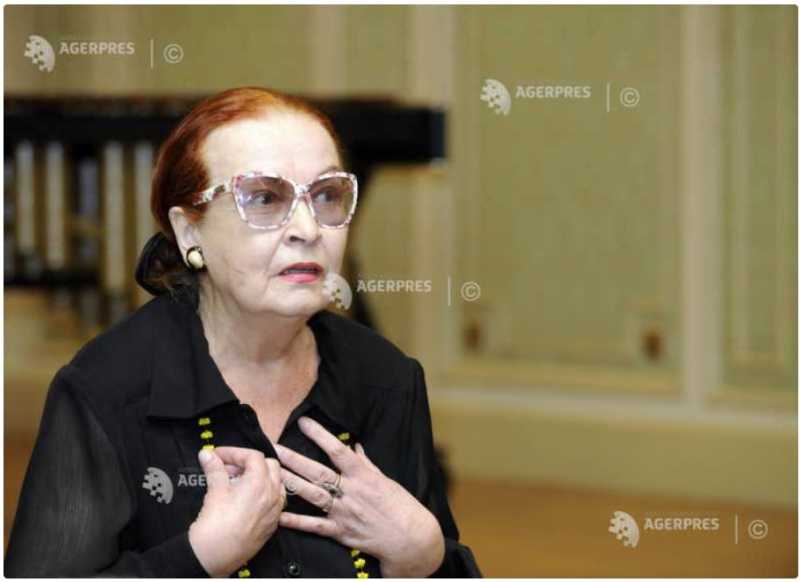
Former TV presenter Sanda Taranu dies at 87; UNITER praises her rare elegance and dignity
Sanda Taranu, former Romanian Television (TVR) presenter (1963-1998), actress, radio and TV host, journalist and translator, has died on May 29 at the age of 87. The National Union of Romania's Stage Performers - UNITER announced her passing on Saturday, calling her 'an emblematic figure of the Romanian Television - a calm, warm voice, a person of rare
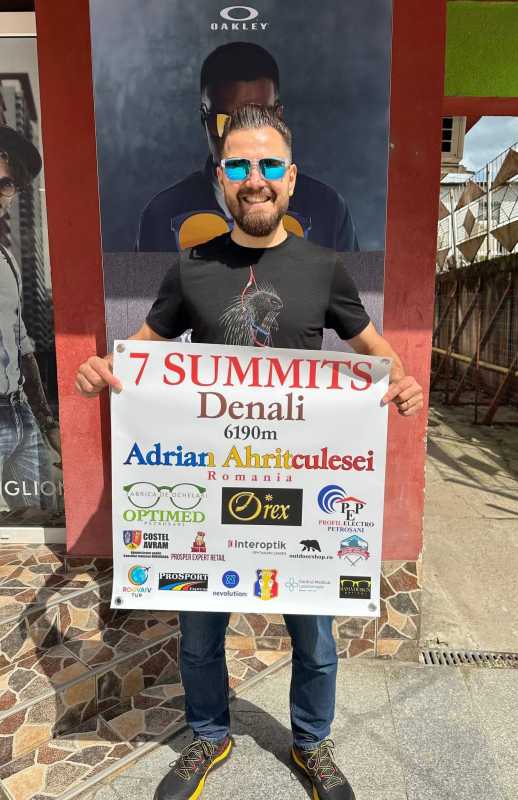
Climber Adrian Ahritculesei heads to Alaska to attempt Mount McKinley, his final Seven Summits peak
Romanian climber Adrian Ahritculesei from Petrosani left for Alaska on Monday to attempt Mount McKinley (Denali), the 6,194-metre peak that is the highest in North America and the last summit he needs to complete the Seven Summits challenge. The Seven Summits circuit includes the highest peaks on each of the seven continents, and Ahritculesei has already succe

Children's Day/Nicusor Dan:This celebration is a commitment to building a Romania where every child is protected and heard
President Nicusor Dan said on Monday, on the occasion of Children's Day, that the celebration represents more than a moment of joy - it is a commitment by society to create an environment in which every child is protected, respected and encouraged to follow their dreams.
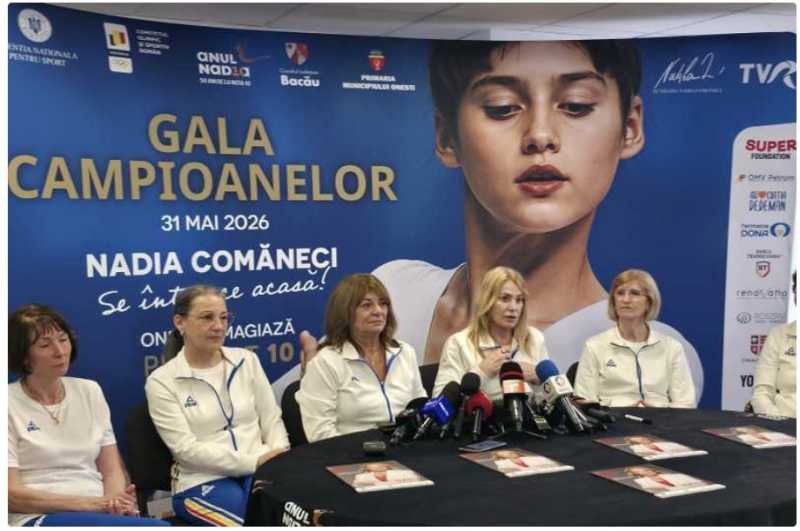
#NadiaYear/Comaneci urges sport boost, hopes children will thank parents for guiding them to gymnastics
Legendary gymnast Nadia Comaneci said on Sunday that she hopes the year marking the anniversary of her historic first perfect 10 in gymnastics at the 1976 Montreal Olympic Games will help children understand the importance of sport. At a press conference in her hometown of Onesti, Comaneci said: 'We hope this year will be a boost for all children to unders

#NadiaYear/ Nadia Comaneci urges restart for sports education, calls for investment in sport infrastructure
Legendary gymnast Nadia Comaneci was in her native town of Onesti on Sunday for the apparatus finals of the 'Nadia Comaneci - Perfect 10' International Gymnastics Competition. She was greeted outside the 'Nadia Comaneci' Sports Hall by dozens of children who chanted her name, offered her flowers and took photos with her. Before e
Defense Ministry: Drone that hit Galati block was kamikaze-type, GNSS-guided, carrying 30-kg explosive charge
The National Defense Ministry released on Sunday further technical details following the examination of the drone that crashed into a residential building in Galati in the early hours of Friday. According to the ministry, the object was a GERAN-2 aerial drone of Russian manufacture, with investigators identifying evidence to that effect, including a partially

President Dan confirms Galati-crash drone was Russian, vows no life-threatening incident will be downplayed
President Nicusor Dan announced that the drone which crashed in Galati in the early hours of Friday was a Geran-2 of Russian origin, stressing that Romania 'will neither ignore nor downplay' any incident that endangers the lives of its citizens, national security or the sovereignty of the Romanian state. 'This is the unequivocal conclusion of the t
UN Security Council to meet in emergency session on Monday following Galati drone incident
Romania's Ambassador to the United Nations, Cornel Feruta, announced that an emergency session of the UN Security Council will take place on Monday at 3:00 p.m. local time at the UN Headquarters in New York, following Romania's request. 'Immediately after the incident involving the Russian drone that exploded on the apartment building in Galati, Ro

Children's Day/PM Bolojan:Romania's children deserve to grow in a society that offers them safety, education & care
The children of Romania deserve to grow up in a society that provides them with safety, education, care and the chance to follow their dreams, acting Prime Minister Ilie Bolojan said on Monday, on the occasion of Children's Day. He added that a country must be built for the young generation, that they can trust and where they will want to stay.

Drone crash in Galați/Dan tells BBC:Expulsion of Russian ambassador not ruled out over further incidents
Romanian President Nicușor Dan said in an interview with the BBC on Saturday, he has no doubt it was a Russian Geran-2 drone which entered his country's airspace and hit an apartment block in the east of the country, following an incident involving an attack on the Ukrainian port of Reni, in the Danube region. In the interview, President Dan did not rule out expelling th

Nadia Comaneci: I'm proud of the girl from Montreal; I always wanted to discover my limits
The great gymnast Nadia Comaneci, decorated on Saturday by President Nicușor Dan with the National Order of the Star of Romania in the Grand Cross degree, spoke about the moment she became Olympic champion at just 14 years old, saying that, looking back, she is proud of the child she was and of the courage she had back then. The distinction was offered to him

Nadia Comaneci - decorated with National Order of the Star of Romania in the rank of Grand Cross
The great gymnast Nadia Comaneci was decorated, on Saturday, by President Nicusor Dan, with the National Order of the Star of Romania in the rank of Grand Cross. The President said, before the decoration, that currently, the word 'exceptional' is perceived differently. 'If we look at the news, yesterday we see that 100 exceptional th
MapN signs contracts for armored vehicles, anti-drone systems, ships and ammunition,within SAFE Program
The Ministry of National Defense (MApN), through the General Directorate for Armaments, signed on Friday several major contracts for equipping the Romanian Army, within the SAFE Program (Action for Security in Europe), the institution announced. 'The Ministry of National Defense, through the General Directorate for Armaments, signed on Friday, May 29, the

Nadia Comaneci, celebrated at Palace of Parliament on 50th anniversary of first 10 in history of Olympic gymnastics
Nadia Comaneci was celebrated, on Friday evening, during a special gala organized at the Palace of Parliament in Bucharest, 50 years after the first 10 in the history of Olympic gymnastics, obtained at the Montreal Games. The multiple Olympic, world and European champion was applauded on the open stage for her achievements as an athlete, but also for her work
#NadiaYear Simona Halep: Nadia means perfection, she was with me even in the hardest moments
Former tennis player Simona Halep participated on Friday evening, at the Palace of Parliament, at the gala dedicated to the 50th anniversary of the first 10 mark in the history of gymnastics, won by Nadia Comaneci, where she stated that the former great champion was always by her side in the important moments of her career. 'Nadia has always supported me i