

INTERVIEW/ Igor Grosu: Transnistria's reintegration with Republic of Moldova is just a matter of time

Transnistria's return under the authority of Chisinau is 'just a matter of time', Igor Grosu, Chairman of the Republic of Moldova's Action and Solidarity Party (PAS), told AGERPRES in an interview where he looked at the tasks standing before his party after its win of the September 28 parliamentary elections.
Grosu explained that the population of the breakaway region understand the importance of Moldova's joining the European Union, as proves the fact that PAS got 40% of the votes on the left bank of the Dniester. Also, Grosu mentioned that with 80% of Transnistrian exports reaching the markets of Romania and the European Union, the economic factor could be a strong drive for this development.
The PAS leader spoke about the need for Russian troops to pull out of Transnistria, but also about the scenarios for Moldova's accession to the European Union with or without Transnistria.
Grosu also looked at the future PAS government to be installed as soon as the Constitutional Court validates the results of the legislative elections.
Here are extensive excerpts from the interview:
AGERPRES: You are the leader of the most influential political formation in the Republic of Moldova at the moment, the Action and Solidarity Party (PAS), winner of the September 28 parliamentary elections. What does this result show: a reduction in the influence of pro-Russian parties, or a rise of pro-Europeanism in the Republic of Moldova?
Igor Grosu: It's a mix of factors. Obviously, the Moldovan citizens have given a very clear vote. They want the Republic of Moldova to be part of the big European family. By the way, we came out victorious both in the country and in the diaspora. So on this point our opponents no longer have reasons to try to turn it around, to claim that we won here, but not there and so on. So it was a blanket victory. We secured the majority both in the country and in the diaspora. I am happy because, throughout the campaign, this was my message at the meetings with the citizens. We have more than once experienced the truth of the saying that the diaspora saves the day, but I insisted that we should also win the domestic vote, as the diaspora will anyway do their part. And I am happy that somehow this message got through. We very clearly won in the country, we even made progress in some regions, especially in the north, which for years was a stronghold of the socialists, of the communists. Now we have very determinedly made some inroads in those districts.
The security factor also mattered very much, because one cannot help but see what is happening in Ukraine. Our citizens have relatives and friends there, they know the reality from TV or the internet, they communicate. We still have many Ukrainian refugees on our territory, women, children, elderly. So it was a combination of factors and in the end it was a beautiful, desired, hard-earned victory both in the country and abroad, and I congratulate all our citizens for this.
Our fellow Moldovans in Romania also delivered. They nearly equaled the turnout of Romania's second presidential round, which saw the highest mobilization.

AGERPRES: This victory does not wipe out the Russian threat to the Republic of Moldova ....
Igor Grosu: It definitely doesn't. Unfortunately, we have lived and are living permanently with this threat, which, at one time was more obvious, more pressing, less so at another times, but it persists, we must not delude ourselves. Now, even with a war in our vicinity, I believe that as far as very sensitive chapters are concerned, those related to security areas such as energy security, we are in a better position. Thank God, we are well secured in terms of gas supply. In terms of electricity, we still have a little to go until we complete the Isaccea-Vulcanesti-Chisinau high-voltage interconnection and we'll undo this vulnerability too.
After several harsh and unjust embargoes imposed by the Russian Federation, export markets are now diversified. We have learned the lesson of laying emphasis on quality - like when we talk about wine, for example. Last year, exports of IT products and services reached one billion dollars, which is a solid indicator. We are happy about this because it is a promising area.
I am not saying this to lull people into a state of relaxation, there are dangers, of course. They will regroup, they will try other methods. Cyberattacks, like in your case and all over the world, are just everyday issues. They require a lot of investment in securing critical infrastructure systems, especially for the banking sector, the cyber sector, all services in general. Now we have over 70% of digitalized services. This is an enormous advantage for citizens, for business, in the relationship with the state. At the same time, new challenges are emerging. We must make sure that such attacks, interferences, do not disrupt the system, but we are learning, they learn too. We are not trailing in class. We learn our lessons well.

AGERPRES: And Ukraine's resistance is vital for the Republic of Moldova ...
Igor Grosu: Absolutely. The resistance of Ukraine defends us, defends the entire Europe, Romania included. So they are defending the whole of the European Union now. We are located so close, and we will help as much as we can, we will help them with whatever we can.
AGERPRES: You landed 55 seats in the new Parliament, you have a simple majority. Do you consider governing alone or together with another left-wing political formation?
Igor Grosu: No. We have the comfort of governing alone. But, I repeat it, as I have said it before, we are open to cooperation. If deputies, political groups and factions - because the Constitutional Court is going to have the last word - will want to contribute, to vote for laws and legislative initiatives (because we'll have a lot of work, both in the process of law approximation & negotiation, as we hope to open negotiations on the six clusters very soon), we will be very happy to get their input, but we need this to be done in honesty, this openness should not be faked, because we will very quickly realize whether it is sincere or not. /.../
Grosu went on to say that 2028 is a pivotal year for Moldova's EU accession, as a clear deadline to complete the necessary reforms and negotiations. He explained that the current parliamentary majority sees this as a historic opportunity and is committed to acting swiftly to ensure all preparatory work is done in time, whereas the future Moldovan government is expected to maintain continuity, keeping the ministers who have proven themselves in the EU accession process since 2022. While some discussions and consultations are still pending, those who have delivered results are likely to remain in their positions, Grosu said.
Speaking of his own options, the politician said that he would rather serve in Parliament, as he believes his presence is needed there because PAS now has fewer seats (55 vs. 63 previously), requiring better organization; he also emphasized the importance of parliamentary diplomacy - maintaining contact with European counterparts to inform them about Moldova's decisions and progress. In conclusion, despite his executive experience, he feels his role should be in Parliament at this time, Grosu explained.

AGERPRES: There are talks about the need to continue reforms in the Republic of Moldova. What are the legislative priorities of PAS during this term?
Igor Grosu: As already pledged, we will have to continue the reform of the judiciary. We are not, I would say, even halfway there. It turned out to be a much harder process, with more rough patches than expected, and which encountered resistance in the system. (...) We were forced to apply what is called external evaluation. The system was not able to self-assess, to self-cleanse, and then we had to intervene with an external evaluation instrument, which greatly disturbed the system that put up resistance, and this took us quite a long time, not even four years were enough. We admit that.
Only now, can I say that we have the first signals or the first results, outputs, which translate into court rulings on high-profile cases, on combating grand corruption, organized crime and so on. This is the only way citizens understand it. You don't have to tell them that you have amended I don't know what laws, the criminal code, the criminal procedure code, the civil code and what not, people want to see justice at work, they want to see justice served and the offenders punished, the corrupt being held accountable before the law. The reform of the judiciary is crucial, and we will carry on with it.
Attracting investments... It's a very good moment now, we call it a kind of investment optimism against the background of the election results. The win of the pro-European party sends a very good signal to the business environment. We are also discussing very intensively with our colleagues in Romania, because at the beginning of the war, unfortunately, part of our business also migrated to you, in a perfectly logical conjuncture - it's not about being upset, people, investors are analyzing very carefully, including the security aspect - but I believe that we have enough opportunities and arguments to try to attract them, including investors from Romania, because they are the closest, and the linguistic and cultural environment, the very good political relations are at an unprecedented level now. Beyond inter-institutional relations, we are just a phone call away from inquiring about what is happening and from facilitating a process, for example. So it is a very good opportunity.
Digitalization I already mentioned. We are taking this subject very seriously: 70% of our services are digitalized and we must go further in this direction.
Investments in infrastructure are also very important. We have already started several projects with the Romanian side, in the energy sector: beyond the southern interconnection, we have two more very important ones, the Suceava-Balti and the Gutinas-Straseni projects. The latest good news that came from across the ocean is that the US government has decided to help us: it's about 130 million dollars, which will be invested in another electricity interconnection, so that we can be sheltered and secure.
Other necessary reform initiatives envisage health care, and education. These are very clear priorities./.../
Speaking about the vulnerabilities of the Republic of Moldova's economy, Igor Grosu said that it still struggles with inefficiency, bureaucracy being the main obstacle. 'We need to debureaucratize many processes,' he said, pointing out how difficult it is for investors to navigate the maze of permits and approvals needed to start a business, obtain residency, or develop real estate projects.
Grosu stressed that while reforms are underway, Moldova must move faster and more decisively so as to strike a balance between necessary security checks and an investment climate that is genuinely open and efficient.
Another key priority is access to affordable financing, with the Moldovan politician highlighting the European Union's €1.39 billion assistance package, which will fund infrastructure, water management, irrigation, and credit lines for small and medium-sized enterprises. These investments, he said, should provide 'cheap and easy money' for entrepreneurs and boost the country's development potential.
The Moldovan diaspora also plays a crucial role in this vision, as many citizens who have built successful businesses abroad are now seen as potential investors at home, capable of bringing not only capital but also valuable experience and know-how.
Igor Grosu referred to infrastructure projects, particularly road building, as a growth engine, explaining that the sector currently absorbs EU funds effectively but lacks enough companies to meet demand. Expanding this capacity, Grosu noted, would generate business across related industries - from construction materials to local services - multiplying the economic impact.
Asked to assess Transnistria's situation, the PAS Chairman took a three-pronged approach. Economy-wise, he said that Transnistria's economic model collapsed because it relied on just apparently free Russian gas, but in fact accumulating ~$11 billion in debt. With gas now restricted, Transnistrian industry struggles, incomes have fallen below those on the right bank of the Dniester, and tens of thousands now commute to work in Moldova.
As far as the security dimension is concerned, he said that Moldova successfully prevented Transnistria from being used as a staging ground for Russian attacks on Ukraine (particularly toward Odessa), and neither did Transnistria escalate tensions, understanding this wasn't in their interest. He also dwelled on Moldova's helping hand to Transnistria last winter, when Russia cut the gas to the breakaway strip, but Chisinau provided assistance to avoid a humanitarian crisis among the 300,000+ citizens there, despite this being politically unpopular. Grosu stressed that this was to prevent Russia from creating a humanitarian/political crisis for blackmail purposes.
On a political level, he noted that 40% of Transnistrian voters who came to cast their ballot in special polling stations in Moldova supported the pro-European candidates, which Grosu sees as evidence of changing attitudes despite the still heavy propaganda.

Briefly put, he said, Moldova treats Transnistrians as citizens while refusing Russian economic leverage, maintaining stability without escalation. He also voiced his opinion that a peaceful integration of this territory with the Republic of Moldova is just a matter of time and that Moldova must be prepared for this moment, that however requires the blessing of very large geopolitical players - the European Union, the United States of America, and even Russia.
AGERPRES: Can the situation in Transnistria affect Moldova's EU accession process?
Igor Grosu: I believe it can no longer affect it. Quite the opposite, EU integration can help speed up solving the Transnistrian issue. The region is highly integrated into international trade - over 80% of its exports are bound for the EU market, especially Romania. They benefit from trading with the EU because it's sustainable, safe, predictable, and has strong purchasing power.
There will always be attempts to derail this, like during the campaign when someone proposed federalization - which has been the Kremlin's dream since the Kozak plan. That would give Tiraspol and Gagauzia veto power over all foreign policy decisions, blocking our EU integration, but evidently we will not accept this under any circumstances.
People can see the clear difference between the left and right bank - the quality of services, income levels, and opportunities the EU offers, including freedom of movement, study in European universities, and travel. Especially after Russia's invasion of Ukraine, things have become black and white. The old narrative of Moldova as a 'bridge between East and West' has disintegrated.
AGERPRES: Have you discussed with European officials about the possibility of Moldova joining the European Union without Transnistria?
Igor Grosu: Obviously we have discussed it. There is also a precedent within the European Union - that is Cyprus.
In our case, we can talk about two scenarios. Joining In one step, with the entire territory of the Republic of Moldova, or in two steps - the territory controlled by the constitutional authorities of the Republic of Moldova and, later on, the second step - the territory on the left bank of the Dniester. (...) It will all depend on several factors and on our speed in the process of joining the European Union. Reforms are one factor, because people ultimately judge through the prism of comfort, accessibility of services, the perspectives offered by one or the other bank of the Dniester. And, as I was telling you, it was a bit surprising for us to see that almost 40% of voters on the left bank of the Dniester River have a pro-European option, which is a good indicator.
AGERPRES: Is the EU accession of the Republic of Moldova together with Ukraine a realistic solution or do you consider taking advantage of your own window of opportunity?
Igor Grosu: Both the Republic of Moldova and Ukraine deserve to have the same start, so that we can start negotiations together. We know about the discussions taking place between the member states of the European Union. Assessments for the Republic of Moldova are positive. We have successfully completed the bilateral screening, our specialist teams of negotiators were praised by Brussels, as I said, we believe that both states deserve to have the same start. Subsequently, each one sets its own speed to negotiate the six clusters. Of course, each country is assessed on merits. So, yes, we believe that we must have the same start, after that, each one will join depending on its proven performance but, certainly, both countries deserve to be members of the European Union.

AGERPRES: For Ukraine, there could be opposition from Hungary, for example. Should this happen, will the Republic of Moldova seek a course of its own?
Igor Grosu: We are aware that Hungary is raising some issues as concerns Ukraine. At the same time, we know that discussions are taking place at EU level to find a solution to unblock this. Somehow, in our case, they waited for elections to conclude. It was also a moment of truth, to see if the Moldovan citizen will vote to further support the pro-European option or not. Here it is, it happened! With a clear majority, not wafer-thin, both in the country and abroad. These are the discussions we are having now. We have made our case, now a political decision is needed, a solution that I know is being discussed at the level of EU member countries. And at the latest summit that took place in Copenhagen, this topic was raised again. I hope that in the very near future we will have a decision so that we can open negotiations./.../
Asked about his meeting on October 9 with the President of Romania, Nicusor Dan, Igor Grosu said that they discussed the situation in Chisinau after elections, developments in Bucharest, and the need for stability and predictability on both sides of the Prut to advance joint projects and investments. He added that they also talked about countering Russian interference, ongoing bilateral projects, and the timeline for validating Moldova's election results. Grosu also noted that the discussions with the Romanian side were optimistic and that he hopes Romania will maintain a stable government, as this benefits both countries. AGERPRES (RO - writing by: Cristian Lupascu, editing by: Mariana Ionescu, Gabriela Ionescu; EN - writing by: Simona Klodnischi)
The content of the www.agerpres.ro website has the exclusive purpose of public informing.
All the information published on this website by AGERPRES is protected by relevant legal dispositions.
It is forbidden to copy, reproduce, recompile, decompile, distribute, publish, display, modify, create derived components or products or full services, as well as any exploitation of the site's content.
Details in the section Terms of Use. If you are interested in picking up AGERPRES news items, please contact the Marketing Department – marketing@agerpres.ro.
The use of the Comments section entails your obligation to respect the AGERPRES terms and conditions in regards to the publishing of comments on the www.agerpres.ro.
Other news in category
CultMin Demeter on Romania attending Frankfurt Book Fair 2028: I am waiting for a Publishers' Association proposal
The interim Minister of Culture, Andras Istvan Demeter, on Monday said that he is waiting for a proposal from the Romanian Publishers' Association (AER) to deal with Romania's participation in the International Book Fair in Frankfurt 2028, as guest of honour, otherwise this responsibility will be entrusted to the Office of Film and Cultural Investments (OFIC).
Fifth TusnadEcoBear international conference on human-large carnivore coexistence set for Oct. 20 - 23
The fifth edition of the TusnadEcoBear international conference, dedicated to human coexistence with bears and other large carnivores, will take place in Baile Tusnad over October 20 - 23, bringing together researchers, wildlife managers, conservation experts, policymakers, NGOs and local community representatives. According to the organizers, the event is bas
Targu Mures selected by European Commission among first six municipalities to host Citizens' Energy Panel
Targu Mures Municipality has been selected by the European Commission (EC), through the Citizen Energy Advisory Hub initiative, as one of the first six municipalities in Europe to organize a Citizens' Energy Panel. The local administration will host the launch event for the initiative on October 15, 2026, with the main objective of testing the 'Eco-Nei
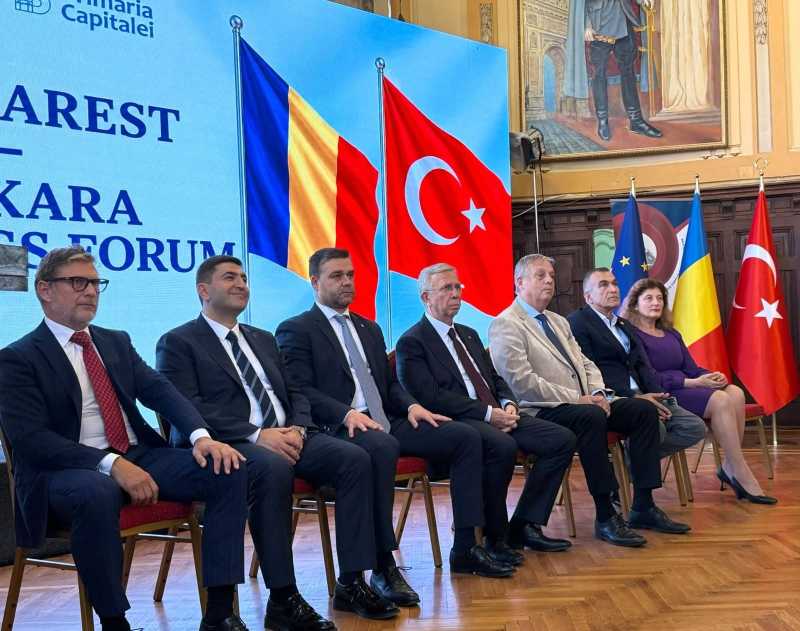
Bucharest and Ankara aim to develop economic cooperation and business partnerships
Representatives of public administration and the business community from Romania and Turkey discussed the development of bilateral economic cooperation and the identification of new business opportunities during the Bucharest-Ankara Business Forum, an event organized by the Bucharest Chamber of Commerce and Industry (CCIB) in partnership with the Bucharest City Hall, on the
Patriarch Daniel sends well-wishes to Pope Leo XIV ahead of lung surgery
Patriarch Daniel of the Romanian Orthodox Church sent a message to Pope Leo XIV on Monday, wishing him 'plenty of help from God' with the health issues he faces. 'In this time of trial, we pray to our Lord Jesus Christ, the Healer of our souls and bodies, to relieve Your Holiness's suffering and grant you good health, so that you may continue y

Judge clears Crevedia explosion case for trial; EUR 53 mln in damages sought
A judge of the Racari Court in Dambovita County ruled on Monday to begin the trial on the merits in the case in which the two owners of the Crevedia LPG station, Ionut Doldurea and Cosmin Stanga, have been indicted in connection with the explosions of August 26, 2023, which left six people dead and 54 injured. The case was sent to court by the Prosecutor Gener
Re-liberalization of gas market, 'gas release' program, and Black Sea gas: Romania's chance to become an energy hub
The re-liberalization of the gas market, the resumption of the 'gas release' program, and gas extraction from the Black Sea could be Romania's opportunity to become a significant market—the energy hub that is constantly being discussed—Septimiu Stoica, Chairman of the General Meeting of Shareholders of the Romanian Commodities Exchange, stated on Mond

PSD rules out support for technocratic or hybrid gov't
National leader of the Social Democratic Party (PSD) Sorin Grindeanu said on Monday that he will not support a technocratic government or a hybrid government made up of social-democratic and technocrat ministers. At a news conference at the PSD headquarters, Grindeanu was asked if he excludes in any way PSD offering its support for a technocratic government or
Writer Norman Manea celebrated in Bucharest on his 90th birthday
A wide-ranging series of events dedicated to writer Norman Manea, marking his 90th birthday, will be held in Bucharest on Thursday and Friday, the National Museum of Romanian Literature has announced. Organised by the National Museum of Romanian Literature in partnership with the Romanian Cultural Institute, the 'Carol I' Central University Library, th

USR's Fritz: We will not engage in backroom deals that would prolong the current agony
The Save Romania Union (USR) will not engage in 'backroom deals' that would prolong 'the current agony,' USR leader Dominic Fritz told Prime Minister-designate Luca Niculescu on Monday. The USR will no longer form a government with the Social Democratic Party (PSD), Fritz stressed at a press conference held at the party headquarters after his m

Interim ForMin: Ceasefire at Black Sea - a priority; Russia must not be allowed to use bread as weapon
Romania supports a ceasefire in the Black Sea region, interim Foreign Minister Oana Toiu said on Monday, stressing that Russia must not be allowed to use bread 'as a weapon.' 'Our priority, from Romania's perspective, is to support a ceasefire at the Black Sea. We have witnessed direct attacks on vessels in the Black Sea's exclusive economi

StateSec Busoi: Romania's gas storage levels - above European average and over 80% target
Romania's gas storage levels are above the European average and exceed the 80% target, with household consumers assured of both price stability and sufficient supplies, as are district heating systems, Secretary of State with the Ministry of Energy Cristian Busoi told the Natural Gas Forum on Monday. He also highlighted the need to continue reducing the bu
BrancusiYear/More than 30 rare photographs by Constantin Brancusi exhibited in Targu Jiu for the first time
More than 30 rare photographs taken by Constantin Brancusi will be exhibited for the first time in Targu Jiu on October 22, as Romania marks the Year of Brancusi and the 150th anniversary of the sculptor's birth, according to a press release issued on Monday by the Constantin Brancusi Research, Documentation and Promotion Centre in this city. The exhibitio
Housing prices in Romania rise 14.4% in 2025, largest increase among European countries assessed (study)
Housing prices in Romania rose 14.4% in 2025 compared with the previous year, the largest increase among the European countries assessed, with the average price reaching 1,917 euros per square metre, according to the Deloitte Property Index 2026 study. According to the study, Romania remains on the fourth place among European countries with the cheapest housin

PM-designate Niculescu:Romania can no longer afford political uncertainty, we urgently need gov' with full powers
Prime Minister-designate Luca Niculescu said on Monday that Romania urgently needed a fully empowered government, not to fill positions but because of concrete problems affecting Romanians' daily lives. In this context, he called on political parties to show an even greater willingness to engage in dialogue and reach a decision. 'We are