

MEP Negrescu: Europe must turn its substantial savings into investment and economic growth

Europe has substantial savings, but investment remains insufficient, and the main challenge is to turn available capital into economic growth more effectively, given that European households hold approximately 10 trillion euros in bank deposits, European Parliament Vice-President Victor Negrescu said on Thursday.
'I would like to begin my speech with a European paradox. Europe has substantial savings, but not enough investment. It has researchers, entrepreneurs and innovative ideas, but too many of our companies seek funding outside the European Union. We have a market of more than 450 million consumers, but our financial markets remain fragmented. European households hold approximately 10 trillion euros in bank deposits. At the same time, the Draghi report identified an additional investment requirement of 750-800 billion euros annually to strengthen Europe's competitiveness,' Negrescu said in a video message delivered to the 'Digital Finance in Central and Eastern Europe' Forum.
According to him, the European Union needs to develop tools that make it easier for companies to access financing and give citizens more options for using their savings.
'This does not mean that we should move people's savings into risky investments - that is not what we should do. It means, however, that we need to build tools that give citizens more options and enable European companies to obtain financing where and when they need it. Europe's major challenge is not only to mobilise more money, but also to turn available capital into economic growth more effectively. This is the objective of the Savings and Investments Union, one of the major reforms of the European project. And I believe that, for Romania and Central and Eastern Europe, this reform could represent a historic opportunity,' the European Parliament Vice-President said.
In his view, the development of Central and Eastern European economies requires stronger capital markets and greater citizen participation in investment opportunities.
'For decades, our economies have been catching up through public investment, European funds and foreign capital. These instruments remain essential. But the next stage of development also requires stronger capital markets, financing for innovative companies and greater citizen participation in economic opportunities. In Romania, the capitalisation of the regulated market reached approximately 579 billion lei at the end of 2025, according to data from the Financial Supervisory Authority. This is significant progress, but the real issue is not just the value of listed companies; it is the ability of the financial market to finance the real economy,' Negrescu explained.
He stressed that digitalisation could make it easier for businesses to access financing, but warned of the risks associated with fraud and the use of artificial intelligence.
'We need innovative Romanian companies to be able to grow in Romania, secure European funding and become international players without being forced to relocate their operations elsewhere, as has unfortunately happened. Digitalisation can accelerate this process. Artificial intelligence can improve risk assessment, reduce administrative costs and make financial services more accessible. Digital technologies can facilitate cross-border investment and give small businesses better access to financing. But digitalisation also brings additional responsibility, because trust is hard to build and can be lost through a single fraud, cyberattack or automated decision that nobody can explain,' the MEP warned.
In this context, Negrescu drew attention to the scale of payment fraud and the need for a regulatory framework that protects citizens without discouraging innovation.
'In 2024, reported payment fraud in the European Economic Area amounted to 4.2 billion euros. This figure shows that digital security is no longer merely a technical issue. It is an economic and social issue, as well as a matter of trust in institutions. That is why the European Union has developed a regulatory framework designed to address these challenges. The Markets in Crypto-Assets Regulation - MiCA introduces common rules for crypto-asset markets. DORA strengthens the digital operational resilience of the financial sector. The AI Act sets out requirements for uses of artificial intelligence that may affect citizens' rights and interests,' he said.
The European Parliament Vice-President called for clear and proportionate rules, as well as consistent implementation of legislation across the Member States.
'We do not need a Europe that regulates every innovation before understanding its potential, but neither do we need a digital market in which citizens are left to bear the risks on their own. We need clear, proportionate rules that are consistently enforced, and supervisory authorities capable of keeping pace with technological developments. This is also why cooperation between national authorities and European institutions is so important. A fintech company that complies with European rules should be able to grow in the single market without having to contend with 27 different administrative interpretations,' Negrescu said.
He also proposed that financial and digital literacy be treated as a strategic investment at European level, given that only a small proportion of citizens have a high level of financial knowledge.
'According to the Eurobarometer survey on financial literacy, only 18% of European citizens demonstrate a high level of financial knowledge. We may have the most advanced applications and the most modern investment platforms, but if people do not understand the difference between saving and investing, between return and risk, or between an authorised product and a fraudulent promise, the digital transformation will remain incomplete. That is why I propose treating financial and digital literacy as a strategic European investment, giving it a stronger place in school education, supporting adult training and developing programmes accessible to vulnerable people,' the MEP said.
Negrescu also said he supports allocating financial resources to the development of digital skills, research and innovation in the negotiations on the future EU budget for 2028-2034.
'We cannot ask Europe to become a technological leader if we do not invest in the companies, infrastructure and skills that make this goal possible. (...) Europe's financial future will not be decided solely by algorithms, digital platforms or new regulations. It will be determined by our ability to turn technology into trust, savings into investment and innovation into prosperity,' Victor Negrescu concluded.
The 'Digital Finance in Central and Eastern Europe' Forum is being held in Bucharest on Thursday, organised by the Financial Supervisory Authority (ASF), in cooperation with the Institute of Financial Studies (ISF). AGERPRES (RO - writing by: George Banciulea; EN - writing by: Simona Klodnischi)
The content of the www.agerpres.ro website has the exclusive purpose of public informing.
All the information published on this website by AGERPRES is protected by relevant legal dispositions.
It is forbidden to copy, reproduce, recompile, decompile, distribute, publish, display, modify, create derived components or products or full services, as well as any exploitation of the site's content.
Details in the section Terms of Use. If you are interested in picking up AGERPRES news items, please contact the Marketing Department – marketing@agerpres.ro.
The use of the Comments section entails your obligation to respect the AGERPRES terms and conditions in regards to the publishing of comments on the www.agerpres.ro.
Other news in category

UPDATE Dan-Merz meeting in Dublin
AGERPRES special correspondent to Dublin, Ireland, Dana Piciu reports: Romania's President Nicusor Dan on Thursday had a bilateral meeting with German Chancellor Friedrich Merz, during the ninth meeting of the European Political Community (EPC), hosted by Ireland, in Dublin. The meeting of Nicusor Dan and Friedrich Merz lasted about 40 minutes, during

Dan-Merz meeting in Dublin
AGERPRES special correspondent to Dublin, Ireland, Dana Piciu reports: Romania's President Nicusor Dan on Thursday had a bilateral meeting with German Chancellor Friedrich Merz, during the ninth meeting of the European Political Community (EPC), hosted by Ireland, in Dublin. The meeting of Nicusor Dan and Friedrich Merz lasted about 40 minutes, during
Foreign minister assures family of Romanian woman detained in China of support in transfer efforts
Romanian Foreign Minister Dan Neculaescu met on Thursday with the family of Alina Apostol, a Romanian citizen serving a prison sentence in China, assuring them that the Foreign Ministry remains fully engaged in supporting her case. 'Through our consular network, we are closely monitoring the observance of all her rights, her detention conditions and her st
BNR keeps monetary policy rate at 6.50pct per annum
In its meeting of November 12, 2026, the Board of the National Bank of Romania (BNR) decided to keep the monetary policy rate at 6.50% per annum. It also decided to leave unchanged the lending (Lombard) facility rate at 7.50% per annum and the deposit facility rate at 5.50% per annum, and to maintain the existing levels of minimum reserve requirement ratios on

'Moldova' Museum Complex manager: Iasi could become regional centre for cultural heritage restoration
The interim manager of the 'Moldova' National Museum Complex in Iasi, Alexandru Chituta, told AGERPRES on Thursday that Iasi could become a regional centre for cultural heritage restoration through the development of the cultural institution's specialist laboratory. According to him, the 'Moldova' National Museum Complex aims to strengthen
Transport minister: Bala 2 working group established to boost energy security, improve Danube navigation
A government working group will oversee the implementation of the Bala 2 project, a key investment aimed at securing the water flows needed to cool the reactors at the Cernavoda Nuclear Power Plant and improving year-round navigation on the Danube, Transport and Infrastructure Minister Stefan-Ovidiu Popa announced on Thursday. 'Energy security and more eff

ICI Bucharest head: Romanian AI Factory infrastructure could become fully operational in 2027
The Romanian AI Factory infrastructure, being developed as part of a European project involving the National Institute for Research and Development in Informatics - ICI Bucharest, could become fully operational in 2027, the institute's Director General, Adrian Victor Vevera, said on Thursday at the 'Digital Finance in Central and Eastern Europe' Forum.

Mocioni Castle in western Romania symbolises Romanian cultural awakening, historian-priest says
The history of Foeni, a village in the Banat Plain of western Romania, is closely intertwined with that of the Mocioni family, renowned philanthropists who built a castle there that became the village's defining landmark and the subject of a book by priest Nicolae Strizu, launched on Wednesday evening at the Theresia Bastion in Timisoara.

Romanian FMCG market is evolving at a moderate pace; consumers have adapted to a state of permanent economic uncertainty.
The fast-moving consumer goods (FMCG) market in Romania continued its positive trajectory in 2026, benefiting from moderating inflation, a slight recovery in purchasing power, and a return to growth in sales volumes; total FMCG sales reached 91.8 billion lei in the first nine months of the year, an increase of 4.8% compared to the same period in 2025, according to a speciali

Romania's automotive industry accounts for 13-14% of GDP, one-third of exports, economy minister says
Romania's automotive industry is a strategic sector that contributes around 13-14% of gross domestic product (GDP) and generates one-third of the country's exports, Economy, Digitalisation, Entrepreneurship and Tourism Minister Daniel Zamfir said on Thursday at an event dedicated to sustainable and affordable mobility. 'I am pleased to discuss the

PM Niculescu announces project for Romania's next 20 years in EU, with youth playing central role
The Government is preparing a project for Romania's next 20 years in the European Union, with young people at its heart, Prime Minister Luca Niculescu said on Thursday, adding that the initiative is intended to be promoted jointly with other EU member states. 'We have had a week with an intensive European agenda. The visit by European Commission Presid

PM Niculescu: Gov't to draw up integrated plan to improve safety in schools, setting out clear responsibilities
The Government will draw up an integrated plan to improve safety in schools, setting out clear responsibilities for all those involved and providing for concrete preventive measures, rapid response mechanisms and firm sanctions for acts of violence, Prime Minister Luca Niculescu said on Thursday. He attended a meeting of the Working Group on the Prevention of
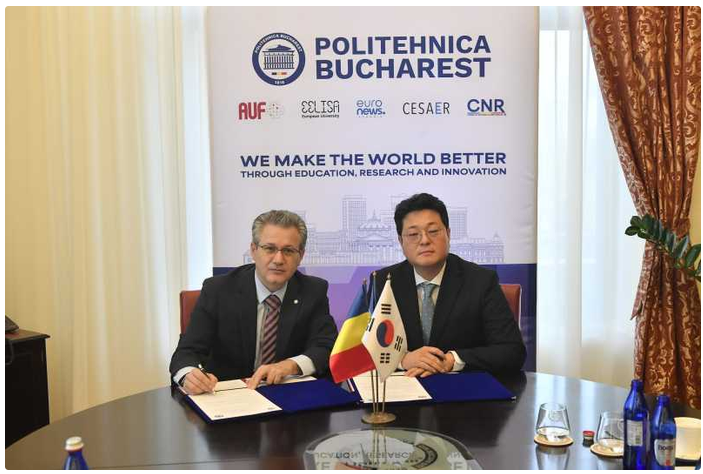
Politehnica University of Bucharest, Hoseo University of Republic of Korea sign cooperation agreement
Politehnica University of Bucharest and Hoseo University of the Republic of Korea signed a cooperation agreement establishing a framework for the development of joint academic and scientific projects, Rector Mihnea Costoiu announced. On Wednesday, Politehnica University of Bucharest welcomed a delegation from the Republic of Korea, comprising representatives o

Historians Alina and Serban Pavelescu, Dennis Deletant win Romanian literary and history prizes
Historians Alina Pavelescu and Serban Pavelescu were awarded the 2026 Monica Lovinescu Prize at the fourth edition of the awards ceremony held on Wednesday evening at the Romanian Athenaeum, while Romanian-British historian Denis Deletant became the first recipient of the E. Lovinescu Prize. The inaugural E. Lovinescu Prize, worth EUR 1,000 and recognising con