

BrancusiYear/Constantin Brancusi was a passionate connoisseur of fine cuisine, a lesser-known trait
Constantin Brancusi, one of the most influential artists of the 20th century, remains a trailblazer in modern global art. Less well known, however, is that the great Romanian sculptor was also a passionate connoisseur of fine cuisine.
Literary critic and historian Cosmin Ciotlos recalls several instances where Brancusi's love of food came to light, sometimes through anecdotal passages, but always revealing.
'When it comes to Brancusi as a gourmet, we all have in mind a number of anecdotal examples. A dinner somewhere in Sarindar, for example, in the company of Pastorel Teodoreanu and a few other writers, memorable because the sculptor would wrinkle his nose at the luxurious dishes served. Or the episodes in which he would welcome foreign guests in Paris with rather fanciful dishes presented as Romanian specialities, always accompanied by champagne poured straight into yoghurt jars. In 1922, he travelled with Raymond Radiguet to Corsica, continually searching for a fish soup he truly liked. Reginald Pollack recounts that Brancusi, without pretension (though surely with a touch of humour), presented himself as one of the world's greatest chefs and that, one afternoon, dissatisfied with his hosts' menu, he rushed to his studio and returned with a splendid roast leg of lamb, which he preferred to the beef tongue that he dismissed as mere ‘cat food',' Cosmin Ciotlos told AGERPRES.
Ciotlos points out that Brancusi had the opportunity to learn gastronomy in the places where he worked after leaving his native village, Hobita, in Gorj County.
'These are all amusing little stories, but I do believe this passion of him was akin to a workshop, a laboratory, a crucible - a mindset he also intensely cultivated in his art. It is well known that in his last fifteen years, roughly after the Second World War, he did nothing but rearrange, again and again, his studio on Impasse Ronsin, paying attention like no one else to light, motion, and the volumetric dialogue of the works - as important to him as the sculptures themselves. A space of intimacy, sanctified by the work it contained. Preserving proportions, it is reasonable to assume that Brancusi's gastronomic passion encompassed not just the result, but above all the process: we are talking about someone who, having fled his native Hobita, started working in 1888 at the Spirtaru brothers' tavern in Craiova up to 18 hours a day, and who, upon arriving in France, supported himself washing dishes in the kitchen of a large restaurant,' Ciotlos emphasised.
In his book 'Colectionarul de sarmale' ('The Cabbage Roll Collector'), writer Cosmin Dragomir devotes a chapter, 'Brancusi, Culinary Critic', to the sculptor, quoting a text by Vintila Rusu Sirianu from 'Vinurile lor'/'There Wines', describing a dinner attended by Brancusi.
'Perhaps you didn't know, but Brancusi was a gourmand and an accomplished gourmet. He loved food, and Romanian cuisine in particular, which he often referenced in his correspondence. (...) There is a moment when, questioned by his fellow diners, Brancusi speaks at the table and reveals his skills as a culinary critic. ‘It was around 1924. (...) Brancusi, Vinea, Darascu, Camil Ressu were at dinner, and they were joined by us, who were inseparable: Cezar Petrescu, Pastorel, and myself. Pastorel, ‘who felt at home in the great restaurants and taverns', arranged an ‘extra' dinner at the Modern. (...) Brancusi visibly enjoyed being among us. (...) After the pickled fish, Pastorel, who had arranged the dishes according to Romanian culinary tradition, imprudently asked Brancusi if he liked the fish. He replied briefly, seemingly pleased to be asked: ‘It's farmed carp. A bit fatty. Quite 'aromatic'... the pickle is a bit long.' He smiled slyly and concluded: ‘Otherwise, it's fine...' (...) ‘How did you like the vegetable stew, master?' Brancusi pierced him briefly with a sidelong glance: ‘The cook made an effort. But effort alone isn't enough. Too much carrot. Cooked over too high a heat. (...) With the pork skewers stuffed with bacon and garlic, coated in cornmeal, we were all satisfied.' Upon tasting two bites, Brancusi muttered under his breath, raising his fork as an exclamation: ‘That's good!''
Dragomir notes that Brancusi left no records or recipes of traditional dishes.
'Unfortunately, from Brancusi we do not have a cookbook or substantial notes that could have served as the basis for such a book, which surely would have been an international bestseller and would have brought Oltenian gastronomy back into the spotlight, deserving far more attention than it currently receives. As a cookbook author, Brancusi would have joined a list of great artists whose names are associated with such publications: from Dali to Frida Kahlo, from Claude Monet to Georgia O'Keeffe, from Hemingway to Dumas. We learn about Brancusi's culinary skills from contemporaries who dined with him, from his correspondence, and other testimonies collected by his biographers. Some of the most memorable stories come from the Modern restaurant (later Berlin, today Control), where he even impressed the gourmet godfather Pastorel Teodoreanu,' Dragomir added.
Brancusi was influenced both by traditional Romanian cuisine and by what he discovered in Paris.
According to the management of the Buzau County Museum, which recently organised the event 'Recipe Notebook', aimed, among other things, at celebrating and transmitting Romanian culinary identity, Brancusi's gastronomy reflects not only food but a certain philosophy of life.
'Gastronomy in Brancusi's time points to two worlds that shaped the artist's life: the Romanian village he came from and modern Paris, where he established himself. In his childhood in Hobita, his diet was certainly simple, as in any Romanian village, aligned with the seasons, work, and religious fasting. This was a cuisine of essentials, based on polenta, bread, beans, cabbage, onions, milk, cheese, eggs, and occasionally meat, especially at holidays. It was a sober gastronomy, yet deeply connected to community, tradition, and purpose. Later, in the big cities and then in Paris, Brancusi encountered a different culinary culture, much more diverse and refined. Early 20th-century Paris was a space of cafes, restaurants, conversation, and the art of living. Yet even living in this sophisticated world, Brancusi remained, in sensibility, close to his original simplicity. Thus, when we speak of gastronomy in Brancusi's time, we are talking not only about food but also about a philosophy of life: respect for ingredients, simplicity, balance, and authenticity. In the same way Brancusi sought essence in sculpture, so too did the world he came from cultivate the essential in food,' Daniel Costache, director of the Buzau County Museum, told AGERPRES. AGERPRES (RO - writing by: Florin Zafiu; EN - writing by: Cristina Zaharia)
The content of the www.agerpres.ro website has the exclusive purpose of public informing.
All the information published on this website by AGERPRES is protected by relevant legal dispositions.
It is forbidden to copy, reproduce, recompile, decompile, distribute, publish, display, modify, create derived components or products or full services, as well as any exploitation of the site's content.
Details in the section Terms of Use. If you are interested in picking up AGERPRES news items, please contact the Marketing Department – marketing@agerpres.ro.
The use of the Comments section entails your obligation to respect the AGERPRES terms and conditions in regards to the publishing of comments on the www.agerpres.ro.
Other news in category

Relics of Saint Lazarus, placed at the Patriarchal Cathedral
A fragment of the relics of the Saint and Righteous Lazarus was placed for worship on Saturday, at the Patriarchal Cathedral, informs the Basilica agency of the Romanian Patriarchate. The faithful will thus be able to meditate in memory of Lazarus, the one whom the Church honors on the eve of the Feast of the Entry of the Lord into Jerusalem. &#

NATO Day/77 years since NATO was founded; Alliance's unity is essential (Senate's Abrudean)
Senate Speaker Mircea Abrudean highlighted on Saturday, in a message sent on the occasion of the 77th anniversary of NATO's founding, that the unity of the North Atlantic Alliance is essential to respond to security challenges and to protect the values that define us. 'Security, solidarity and commitment for a safer future! NATO marks 77 years since it
Reconfirmation of Romania's sovereign rating highlights confidence of international agencies in authorities' ability to continue fiscal consolidation
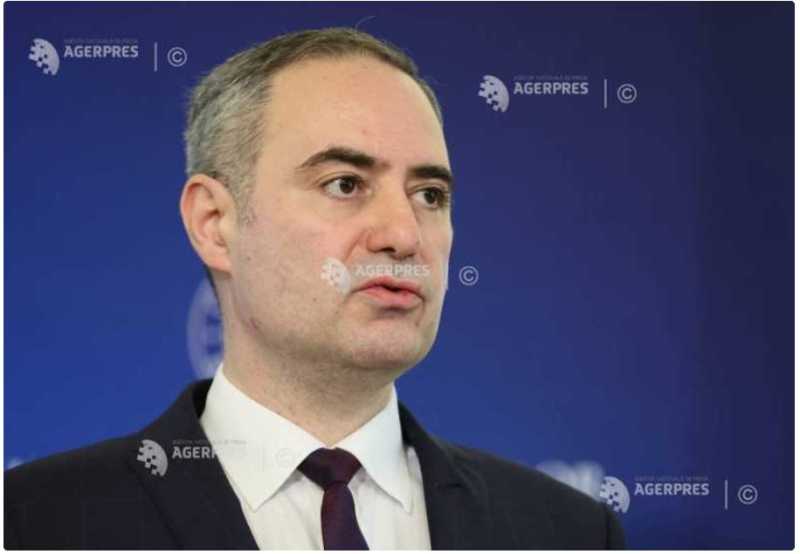
The reconfirmation of Romania's sovereign rating highlights the confidence of international agencies in the authorities' capacity to continue fiscal consolidation and maintain macroeconomic stability, Finance Minister Alexandru Nazare said on Friday, after the financial rating agency S&P Global Ratings reconfirmed Romania's sovereign rating at BBB-/A-3 for lo
'Whirlpool' Vida Lake to turn into sustainable rural tourism site
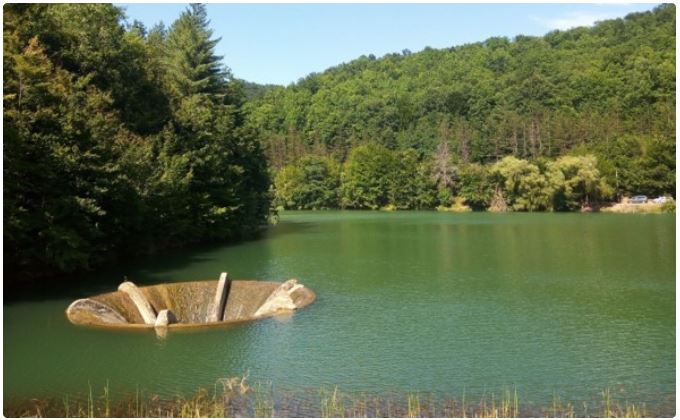
The Dobresti local administration is preparing to turn Lake Vida - one of Romania's most spectacular and unique lakes - into a regional hub for active and sustainable rural tourism, through a project estimated at four million euros, following the completion of complex desilting works. Dobresti mayor Florin Copos recently told AGERPRES that the local author
Amalia Verzea's 'The Art of Stained Glass at 360 Degrees' arrives in Oradea
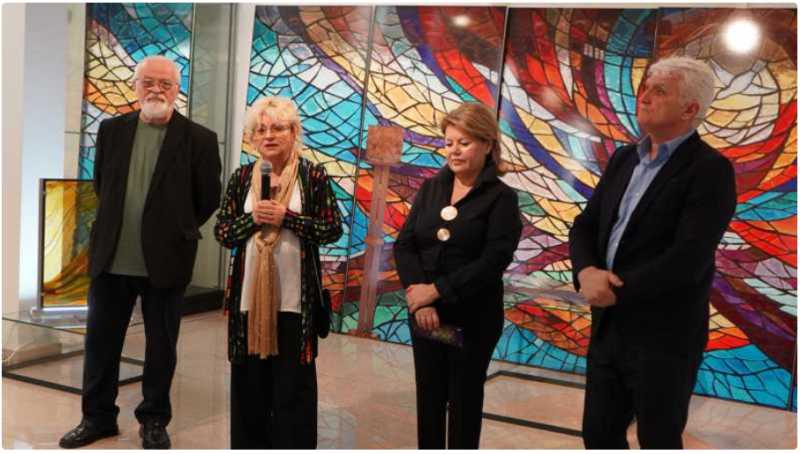
After being presented in Bucharest, the personal exhibition 'The Art of Stained Glass at 360 Degrees' signed by internationally renowned Oradea artist Amalia Verzea, has arrived in her hometown, at the Cris Land Museum, where it can be visited until May 10. The exhibition will later travel to Rome. 'I have been making stained glass all my life. Sin
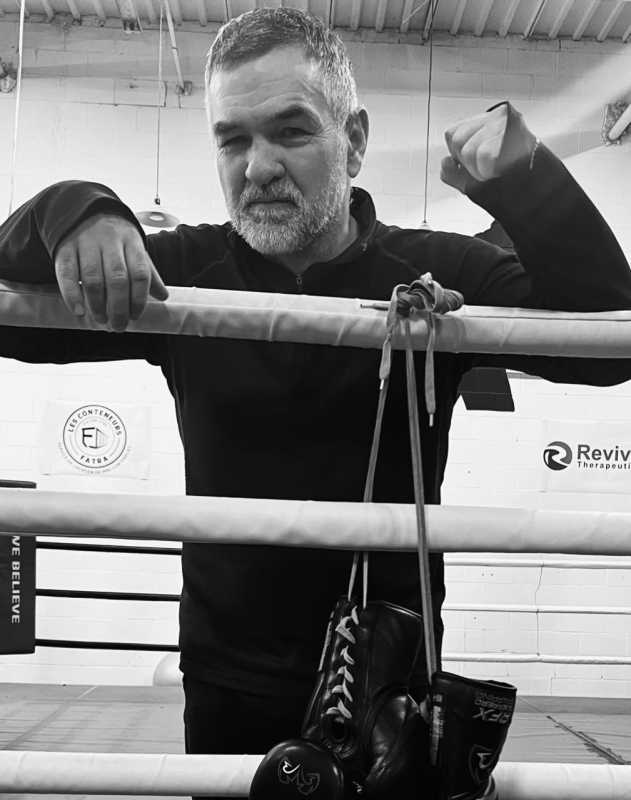
#BoxingCentenary/INTERVIEW Leonard Doroftei: Romanian boxing can rise again, but only with better coaching
Former boxing great Leonard Doroftei told AGERPRES in an interview that Romanian boxing is going through a rather challenging period, but he remains confident the sport will recover and once again produce athletes capable of winning medals at European, World and Olympic level. 'We're going through a tougher patch. I hope that one day we'll bounce b

#Nadia Year/International Day of Sport for Development and Peace celebrated with small gymnasts
The Romanian Olympic Committee (COSR), through the Romanian Olympic Academy on Friday organised an event at the Mariana Bitang Gymnastics Hall inside the Dinamo Sports Club, celebrating International Day of Sport for Development and Peace together with young gymnasts and legends of Romanian gymnastics. The event is part of the series of actions carried out by
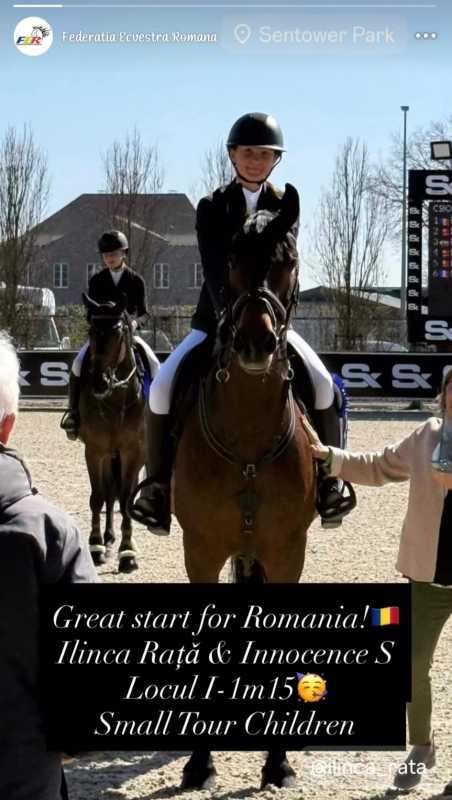
Iasi equestrian wins first place at her debut at CSIO Ch Nations Cup Youth Belgium
Iasi equestrian Ilinca Rata, aged 14, brought Romania its first victory in the CSIO Ch Nations Cup Youth competition, held in Opglabbeek (Belgium). Registered with the Equester Sports Club Iasi, Ilinca won in the debut event for the Children category - Small Tour (1.15 m), after a penalty-free course, performed alongside the horse Innocence S/Ingo.

Ioana Dogioiu: Government approves ordinance on temporary reduction of excise duty on diesel fuel
Government spokesperson Ioana Dogioiu declared on Friday that the Executive adopted the normative act regarding the temporary reduction of the excise duty level for diesel and the establishment of the solidarity contribution on revenues from the marketing of crude oil and energy products obtained from the processing of crude oil extracted from the territory of Romania.

Jianu:Entrepreneurial index for 2026 fell to 43.25 points; only two macroeconomic indicators are increasing
The entrepreneurial index dropped this year to 43.25 points, from 49.5 points in 2025, in conditions in which most macroeconomic indicators stagnated or registered decreases, while the dynamics of turnover and foreign investments were on the rise, data from the third edition of the report show. 'We meet today at the launch of the Romanian Entrepreneurship

One of Romania's main challenges remains high level of energy prices during peak hours (StateSec)
One of Romania's main challenges remains the high level of energy prices during peak hours, and the solutions are increasing domestic production, investing in storage capacities and more efficient management of consumption, according to Energy Ministry Secretary of State Cristian Busoi. 'One of Romania's main challenges remains the high level of en
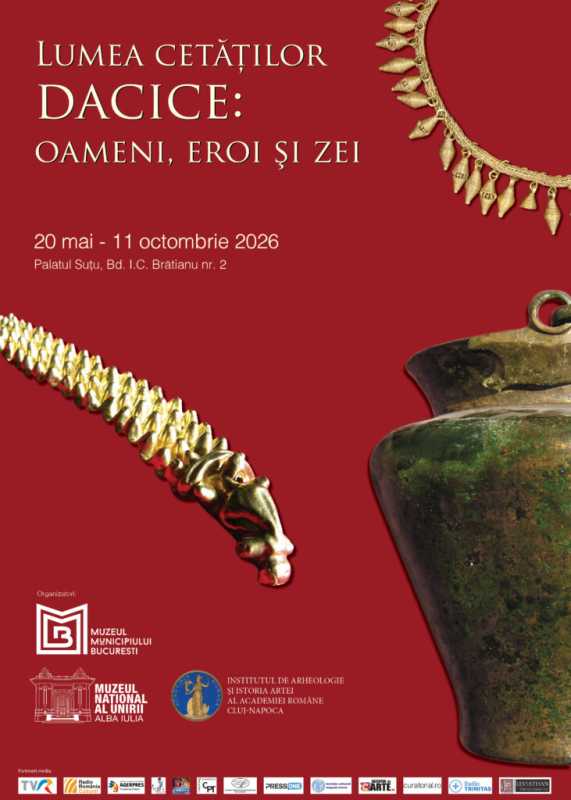
'The World of the Dacian Fortresses: People, Heroes and Gods' exhibtion to open at Sutu Palace
The thematic exhibition 'The World of the Dacian Fortresses: People, Heroes and Gods' will open on 20 May at the Sutu Palace. 'From 20 May, we invite you to the thematic exhibition ‘The World of the Dacian Fortresses: People, Heroes and Gods,' an opportunity to discover the fascinating world of the Dacians and their fortifications, viewed
Romania records tourist arrivals down 3.7% and overnight stays down 3% in February
Arrivals and overnight stays in the establishments of tourists' reception with functions of tourists' accommodation, including apartments and rooms for rent decreased by 3.7% and by 3%, respectively, in February 2026 compared to the same month last year, according to the National Institute of Statistics (INS) data published on Friday. The arriva
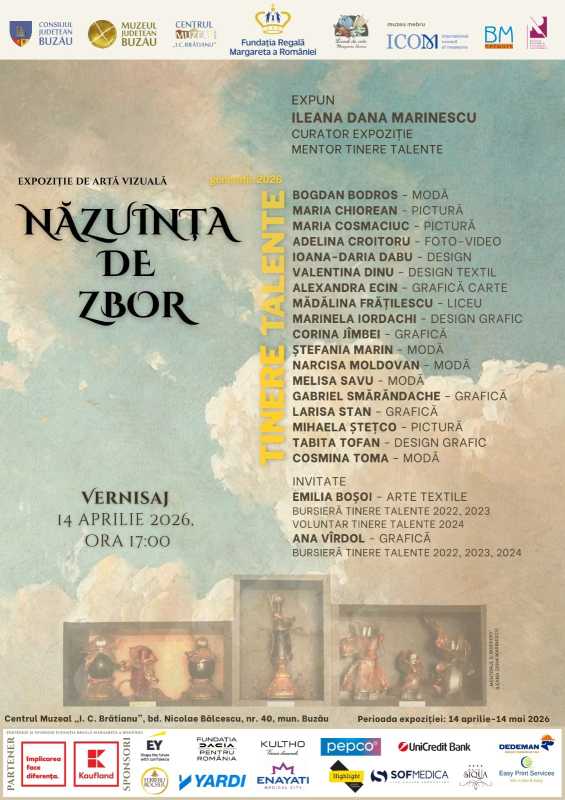
Exhibition dedicated to young artists, organised in partnership with Margareta of Romania Royal Foundation
The Buzau County Museum, in partnership with the Margareta of Romania Royal Foundation, is organizing the opening of the exhibition called 'The aspiration to fly' ('Nazuinta de zbor'), dedicated to young artists of the 2026 generation, an event which coincides with the 130th anniversary of the inauguration of the former 'I. C. Bratianu' hospital build

FEATURE/ Inter-institutional training on the Danube part of Sea Shield exercise
The Sfantu Gheorghe branch of the Danube on Thursday hosted an inter-institutional training exercise that dealt with the management of a refugee crisis in the Danube Delta area and prisoners of war, an event that was part of a wider Sea Shield exercise. The military exercise designed to secure the interoperability of the entities participating in a multination